From Controlling the Storm to Understanding the Climate: Moving from Behaviour Management to Positive Behaviour Support

Reading Time: Approx. 6 minutes
Introduction: The Parenting tightrope
If you are reading this, you are likely exhausted.
Parenting is a relentless job, and when you are supporting a child with complex needs or challenging behaviours, that exhaustion takes on a different weight.
Most of us were raised in a world of "Behaviour Management." It is the way schools operate, the way our parents raised us, and the way society generally expects us to handle things. If a child does something "good," they get a reward. If they do something "bad," they get a consequence. It sounds logical. It sounds fair.
But if you are reading this, you might have noticed that despite the star charts, the time-outs, the stern voices, and the endless negotiations... the behaviours aren't changing. Or perhaps they stop for a moment, only to explode twice as loud later.
There is a different way. It requires a significant shift in mindset, which can be scary, but it is a shift that moves away from "managing" your child and toward "supporting" them. This is the difference between Behaviour Management and Person-Centred Positive Behaviour Support (PBS).
The Old Way: Behaviour Management
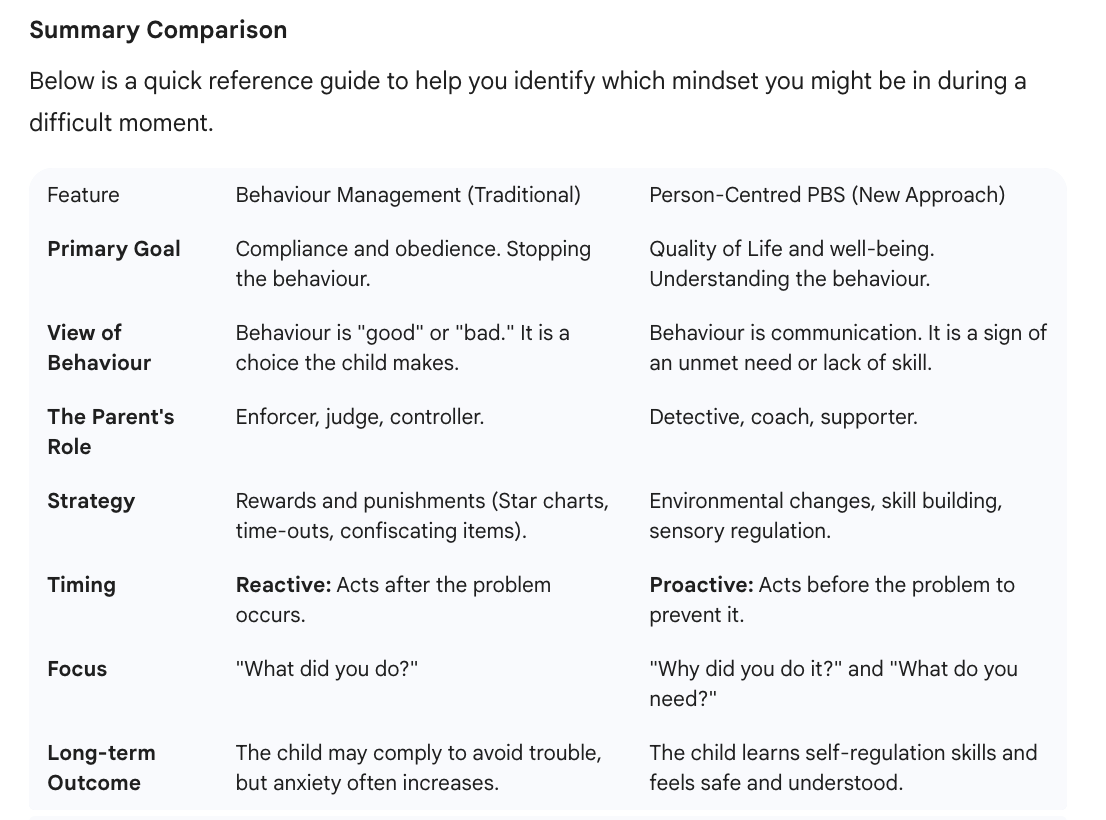
"Behaviour Management" is exactly what it sounds like: it attempts to manage the child. It views the behaviour as the problem that needs to be fixed.
In this model, we often view a meltdown, a hit, or a refusal to listen as "naughty" or "defiant." Our goal becomes compliance. We ask, "How do I make them stop doing that?" and "How do I make them do what I say?"
This approach relies heavily on power and consequences.
The Reward: "If you are quiet in the shop, you get a lolly."
The Punishment: "If you scream, no iPad tonight."
Why it feels like it works (and why it fails)
Behaviour management often works in the short term. If you threaten a consequence, a child might stop the behaviour out of fear or a desire for the reward. This gives us, the parents, a sense of relief. We feel in control.
However, for many neurodivergent children or children with trauma, this approach often backfires.
It ignores the 'Why': It addresses what the child is doing, but not what they are feeling.
It damages connection: It creates a "me vs. you" dynamic. The parent becomes the enforcer rather than the safe harbour.
It assumes skill: It assumes the child could behave if they just wanted to enough. Often, the child wants to do well but lacks the emotional regulation skills to do so.
The New Perspective: Person-Centred Positive Behaviour Support (PBS)
Person-Centred Positive Behaviour Support (PBS) flips the script. Instead of asking "How do I stop this behaviour?", PBS asks "What is this behaviour telling me about my child’s life?"
The core philosophy here is simple but profound: All behaviour is communication.
When your child is screaming, hitting, or shutting down, they are rarely trying to make your life difficult. They are trying to tell you that something is wrong. They might be saying, "I am overwhelmed," "I am in pain," "I am confused," or "I don't feel safe."
PBS doesn't focus on compliance; it focuses on Quality of Life. The theory is that if a child is happy, understood, safe, and engaged in things they love, the challenging behaviour naturally decreases because the need for it disappears.
The Three Pillars of the Shift
To move from Management to Support, we have to change our lens in three specific areas.
1. From "Consequences" to "Adjusting the Environment"
In Behaviour Management, if a child screams in a loud supermarket, we might scold them.
In PBS, we look at the environment. We realize the lights are too bright and the noise is painful for them.
The Fix: We don't punish the scream. We bring noise-cancelling headphones, or we go shopping at a quieter time. We change the world to fit the child, rather than forcing the child to fit the world.
2. From "Stop It" to "Let's Build Skills"
Behaviour Management tries to suppress a behaviour. PBS acknowledges that the behaviour serves a purpose.
If a child hits you to get your attention, Behaviour Management says, "Time out for hitting." The child still needs attention but now doesn't know how to get it.
PBS says, "You need my attention, but hitting hurts. Let's practice tapping me on the shoulder or using a special card when you need me." We teach a replacement behaviour that works better than the hitting.
3. From "Reactive" to "Proactive"
Behaviour Management is usually reactive—we wait for the explosion and then deal with the fallout.
PBS is proactive. We act before the behaviour happens. This is often called the "Green Zone." We want to keep our children in the Green Zone (calm, happy) for as long as possible by meeting their needs early. We feed them before they get "hangry," we provide sensory breaks before they get overwhelmed, and we give warnings before transitions.
A Real-Life Scenario: The Dinner Time Battle
Let’s look at how these two approaches handle a common scenario: A child refuses to sit at the table and throws their food.
The Behaviour Management Approach:
Parent: "Sit down right now or no TV."
Child: Screams and throws peas.
Parent: "That’s it, go to your room. You are being naughty."
Result: The child is hungry and angry; the parent is stressed. The child learns that dinner time is a time of conflict. The root cause (perhaps the chair is uncomfortable, or the social pressure of eating is too high) is never addressed.
The Person-Centred PBS Approach:
Parent (Investigation): Why is this happening? Are their feet dangling? Is the smell of the food overwhelming? Are they too tired to sit upright?
Parent (Action): "I can see you're finding it hard to sit today. Let's try eating this meal at the little table where your feet touch the ground. We can try the big table again tomorrow."
Result: The child eats. The stress remains low. The parent has identified that the child needs more physical stability to eat calmly.
It Is Not Permissive Parenting
A common fear parents have when switching to PBS is: "Am I just letting them get away with it?"
The answer is no. PBS is not about having no boundaries. Safety is still paramount. If a child runs into the road, you stop them. But you don't shame them for it. You stop them to keep them safe, and then later, you look at why they ran and teach them safety skills when they are calm.
PBS is actually more work than behaviour management in the beginning. It requires you to be a detective. It requires patience. It requires you to regulate your own emotions when chaos is happening. But unlike behaviour management, which is a temporary band-aid, PBS builds a future where your child has the skills to cope with the world, and where your relationship is built on trust, not fear.
Moving Forward
If you recognize yourself in the "Behaviour Management" column, please be kind to yourself. You were doing the best you could with the tools you were given. The transition to Positive Behaviour Support is a journey, not a switch you flip overnight.
Start small. The next time a behaviour challenges you, pause. Take a deep breath. Instead of asking, "How do I stop this?", try asking, "What is this telling me?" That single question is the first step toward a happier home.
Working with a PBS Practitioner
The point to this article is, in one sense, that ATS is steeped in personal centred positive behaviour support. We do not practice behaviour management. To work with us means that parents need to make what is sometimes a huge transition.
Even understanding PBS can be challenging - so often our first task in therapy is helping parents to change.
Then, even more radical, our approach to therapy keeps the parents at the centre-circle in PBS methods with the child. We teach the parents how to support their child and also how to parents can ensure that other practitioners or schools come to understand the approach. Parents become empowered to practice PBS and this has the greatest impact for life-long gains.
Positive behaviour support can be for many an investment with a life-long life-changing outcome.