Looking beyond the mandate to the heart of the matter
Dr Jo Bowers PhD
We often hear parents and carers express deep anxiety when the topic of fading out a restrictive practice arises. To a family operating in survival mode, a regulated restrictive practice (RRP)—such as a locked door, restricted access to hazards, or PRN medication—is frequently viewed as the only mechanism keeping their loved one and their household safe. Consequently, the systemic mandate to reduce these practices is often perceived as a threat or a judgment.
However, the clinical mandate to "fade out" restrictive practices is not inherently controversial, nor is it a punishment. It simply requires a broader perspective and a grounded clinical context. For those of us whose clinical careers significantly predate the inception of the National Disability Insurance Scheme (NDIS), we recognise that the current public discourse surrounding RRPs has become unnecessarily polarised by bureaucratic anxiety. It is time to elevate this conversation, moving away from a narrow focus on NDIS compliance to ground our understanding in established clinical, sociological, and international human rights frameworks.
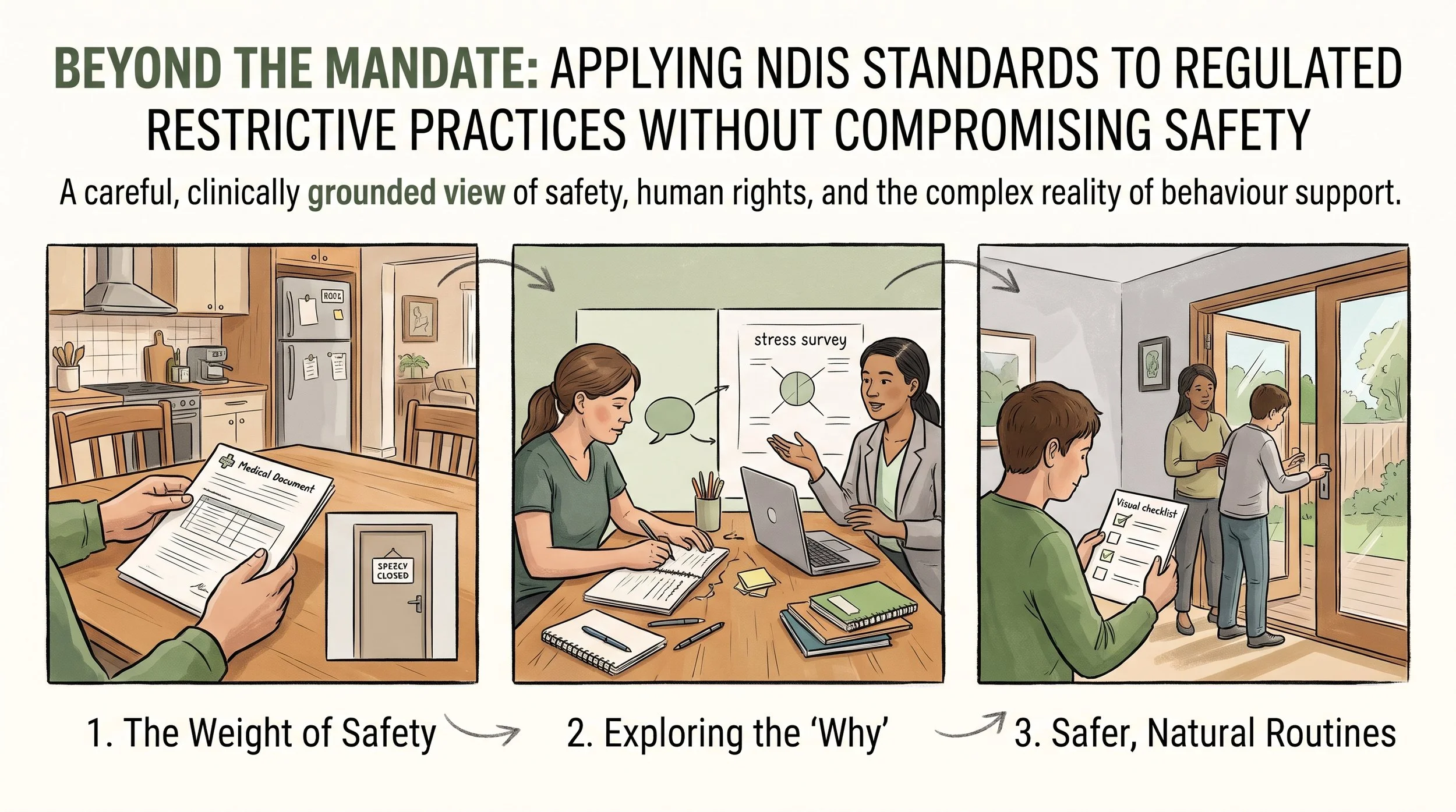
A story board image on navigating the complexities of restrictive practices in daily life
The Historical and Global Context
The clinical oversight of restrictive practices was not invented by the NDIS. Long before the National Disability Insurance Scheme Act 2013 was drafted, state-based systems provided robust guidance on these complex issues. For example, the Ageing, Disability and Home Care (ADHC) framework in New South Wales established comprehensive, holistic guidelines for behaviour support (ADHC, 2012). This pre-NDIS era heavily emphasised person-centred applications of safety, rigorous clinical oversight, and the psychological principle of the "least restrictive alternative." These historical frameworks recognised that while restrictive practices required strict regulation to prevent abuse, their application intersected inevitably with necessary health and safety interventions.
Furthermore, the NDIS does not own the framework for human rights; it merely interprets it. The foundational imperative to reduce restrictive practices stems from the United Nations Convention on the Rights of Persons with Disabilities (CRPD), which asserts the inherent right to physical and mental integrity, liberty, and security of person on an equal basis with others (United Nations, 2006). This global standard challenges clinicians and society alike to ensure that individuals with disabilities are not subjected to arbitrary or disproportionate restrictions.
Navigating the Legislative Matrix
In Australia, the principles of the CRPD are operationalised through the National Disability Insurance Scheme Act 2013 and specifically detailed in the NDIS (Restrictive Practices and Behaviour Support) Rules 2018. Section 21 of the Rules explicitly mandates that a comprehensive behaviour support plan must include "strategies to reduce and eliminate the use of regulated restrictive practices" (Commonwealth of Australia, 2018).
However, these rules do not exist in a vacuum, and they cannot be applied without considering parallel legislation. Practitioners and families must also navigate the Work Health and Safety Act 2011 (WHS Act), which imposes a primary, non-delegable duty of care to ensure the health and safety of workers, participants, and family members by mitigating foreseeable risks (Commonwealth of Australia, 2011). Simply removing an environmental restraint without a viable alternative can place a practitioner or provider in direct breach of the WHS Act.
Additionally, the Privacy Act 1988 mandates the stringent protection of sensitive health information, ensuring dignity and privacy are maintained during clinical assessments and reporting (Commonwealth of Australia, 1988). Balancing the CRPD’s mandate for autonomy with the WHS Act’s mandate for safety—while protecting the individual's dignity under privacy laws—is the true crucible of clinical behaviour support.
The Clinical Reality: FBA and Ecological Systems
Reducing a restrictive practice is a meticulous clinical process, not an administrative checkbox. From a sociological and ecological systems perspective, an individual's behaviour cannot be separated from the environment in which it occurs (Bronfenbrenner, 1979). In clinical psychology and disability health research, behaviours of concern are widely understood as profound distress responses or attempts to communicate unmet needs when adaptive skills are overwhelmed (Emerson, 2001; McVilly, 2002).
Therefore, the Functional Behaviour Assessment (FBA) is far more than a document used to justify NDIS funding. It is a vital clinical diagnostic instrument used to decipher distress (Gore et al., 2013). Only by deeply analysing the biological, psychological, and environmental triggers can a clinician understand why an RRP has become necessary in a family's daily life.
Fading Out: Capacity Building, Not Abandonment
When understood clinically, "fading out" does not mean pulling the safety net out from under a family. According to established antecedent assessment research, proactive skill-building and environmental modifications must be firmly in place before the removal of any protective restriction (Luiselli, 2006).
If a regulated restrictive practice—such as a PRN medication prescribed by a treating psychiatrist—is deemed clinically necessary to prevent imminent harm, and is properly authorised, consented to, and proportionate, it is maintained precisely to uphold health, safety, and the individual's immediate right to bodily preservation.
The true "fade-out" mandate is actually a mandate for capacity building. It is the concurrent, longer-term therapeutic work of expanding the participant's communication skills, emotional regulation, and environmental buffers. We fade the restriction out by naturally outgrowing the need for it, replacing physical or chemical barriers with systemic support and personal resilience.
Navigating complex behaviour support requires immense courage from participants and families. By stepping beyond the narrow lens of NDIS compliance and embracing a globally informed, clinically rigorous, and deeply compassionate approach, we can demystify restrictive practices. We do not compromise safety; we elevate it, ensuring that every intervention honours the humanity, dignity, and ultimate well-being of the individual.
References
Ageing, Disability and Home Care (ADHC), 2012. Behaviour Support: Policy and Practice Manual. Sydney: Department of Family and Community Services NSW.
Bronfenbrenner, U., 1979. The Ecology of Human Development: Experiments by Nature and Design. Cambridge, MA: Harvard University Press.
Commonwealth of Australia, 1988. Privacy Act 1988. Canberra: Federal Register of Legislation.
Commonwealth of Australia, 2011. Work Health and Safety Act 2011. Canberra: Federal Register of Legislation.
Commonwealth of Australia, 2013. National Disability Insurance Scheme Act 2013. Canberra: Federal Register of Legislation.
Commonwealth of Australia, 2018. National Disability Insurance Scheme (Restrictive Practices and Behaviour Support) Rules 2018. Canberra: Federal Register of Legislation.
Emerson, E., 2001. Challenging Behaviour: Analysis and Intervention in People with Severe Intellectual Disabilities. 2nd ed. Cambridge: Cambridge University Press.
Gore, N.J., McGill, P., Toogood, S., Allen, D., Hughes, J.C., Baker, P., Hastings, R.P., Noone, S.J. and Denne, L.D., 2013. 'Positive Behaviour Support in the UK: A state of the nation report', International Journal of Positive Behavioural Support, 3(1), pp. 13-37.
Luiselli, J.K., 2006. Antecedent Assessment and Intervention: Supporting Children and Adults with Developmental Disabilities in Community Settings. Baltimore, MD: Paul H. Brookes Publishing Co.
McVilly, K.R., 2002. Positive behaviour support for people with intellectual disability: Evidence-based practice, promoting quality of life. Sydney: Australasian Society for the Study of Intellectual Disability.
United Nations (UN), 2006. Convention on the Rights of Persons with Disabilities. Treaty Series, 2515, p. 3.
Dr Joseph R Bowers is a PhD in Counselling Psychotherapy and a Senior Specialist Behaviour Support Practitioner who is registered with the NDIS Commission. He has worked full time in behaviour support services since 2011, then under ADHC NSW and with the transition into NDIS Dr Bowers founded Ability Therapy Specialists Pty Ltd to continue offering tailored person centred and international standards of best practice to rural, regional and remote Australians. As a telehealth service, ATS reaches people where they need help - in the home and in your hand via your favourite application for video and audio chats and discussions. Contact us via the form on the home page - scroll down and flip us a note.