Finding a way forward when you are too exhausted to keep fighting the system
Dr Jo Bowers PhD
I struggled so much to get the title of this paper right. I wanted to capture the profound, specific exhaustion I hear from families every single week. In fact, I almost called it,
"Holding the line when you are ready to give up - on the paperwork."
That phrase cuts to the core feeling we get from our clients. Holding the line for your child’s quality of life is already a full-time job. It means how giving up feels like the only option at the moment. The system is too complex. Getting the help you need and that your child needs is too hard.
You know what it means managing a Tuesday morning crisis. You know how navigating a meltdown before breakfast can actually set up your whole day. You are in fact the expert on keeping your household functioning.
And what we tell our parents is that, you are the expert in your child’s needs. We respect your views and your opinions. We want to work with you as a collaborator and co-creator of solutions that work for you and your child.
But then, the hard reality of paperwork hits you in the face. It symbolises the whole mess, actually.
Just while you are managing that very real, very human complexity, your inbox pings. A service provider needs three or four separate intake forms completed—compliance documents, consent matrices, and service agreements—all demanded under the guise of recent "quality standards" and "audit requirements." Suddenly, even the simple act of trying to digitally sign a PDF becomes a demoralizing nightmare that tips you over the edge.
What makes this paperwork so crushing is not just the volume; it is the language.
The system forces participants and families into a corner where they must constantly focus on pathology, weakness, and vulnerability. To get help, you are forced to use disabling language that strips away your child’s humanity and excludes them from their own narrative. One almost has to conclude, the system at the moment just sucks - it is entirely rational that so many families are pulling back from services just to protect their own mental health.
But staying stuck in that dismal reality doesn't get you the support you deserve. We can see there is a proactive, solution-focused pathway forward. Here is how we bridge the gap between the system's demands and your family's real life.
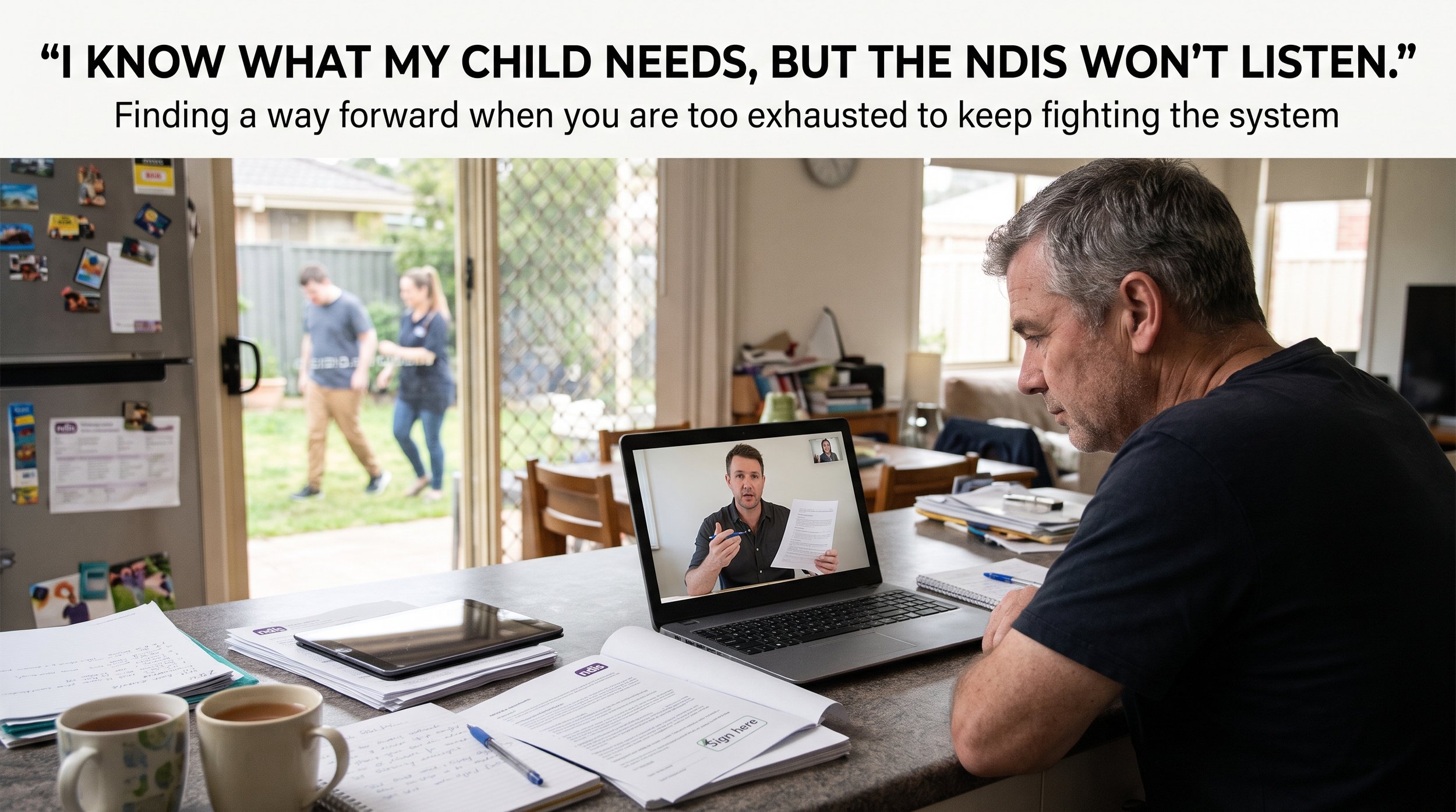
An NDIS client and parent talking it out with a therapist online.
1. Getting the lingo: system vs real life
There is a fundamental language barrier between your home and the NDIA. In real life, you talk about your child’s happiness, their distress, and what makes a good or bad day. The NDIA does not process human stories. It processes "functional impact," "informal support breakdown," and "risk of relinquishment." More so, it demands evidence against criteria that is framed by the system not by families.
When a planner or auditor reviews your file, they are looking for specific legislative triggers. If your daily reality isn't translated into this bureaucratic lingo, the system simply replies with "lack of evidence." Understanding that this is a translation issue—not a reflection of your child’s actual worth or need—is the first step in protecting your sanity.
Best practice in behaviour support under NDIS now needs to translate real life needs into the matrix language as this sits against the NDIS evidence-based criteria. But at the same time, behaviour specialists engaging with participants and families need to explain this crazy system in plain language conversations.
The challenge then is to write up a Functional Behaviour Assessment report that meets the system’s criteria under the NDIS Act, and a Behaviour Support Plan that covers all of the compliance and best practice standards. But at the same time, the practitioner needs to work close in collaboration with the participant and family - because they need to help co-create the assessments and the plan. They must be part of this process for the plan to mean any practical sense.
Behaviour Support Practitioners now sometimes have complex cases where the Functional Behaviour Assessment report caps over 100 pages. Not because the person or their needs are complex, but because the system is now so complex.
From participant’s views, they tell us that the NDIA has erected so many criteria in addition to the Act (or in ways the planners interpret the Act), and with apparent rejections of reasonable and necessary supports, that they can’t get the help they need. We cannot say whether this is the actual case or not, to be sure. But we can see the fall out from a system that appears daunting for participants.
Participants ask us as practitioners to address the NDIS Act in such a detailed way that the case would almost hold up in court. Imagine then, how what used to be person centred support behaviour support assessments have become over burdened by not only clinical language but also legalistic language and criteria to address NDIS compliance as well as judicial legislative frameworks. And all of this, because the system has become over complicated for people who just require disability and/or mental health support.
2. Self-care up-front: how to prevent NDIS burnout
Before you can advocate, you have to protect your energy. NDIS burnout is real, and it happens when you try to be a full-time parent, a case manager, and an administrative assistant simultaneously.
Set administrative boundaries: Designate only one or two hours a week for "NDIS paperwork." If a provider demands an immediate form for their own audit compliance, remind them of your capacity. If you have to budget more time for these tasks, do that - but also take care of yourself in the process. Given yourself small rewards for a task completed. Even if that means a simple cuppa in the midst of a busy day.
De-personalize the process: Recognize that the deficit-based language required for funding is a game you have to play for the system, not a true reflection of your child’s identity. This is so important. Seek out a practitioner with the wisdom and practical sense to see this difference and make it real and practical. Sure, we all must use the language. But we can also use a human and personal language that makes sense in real life.
Outsource the translation: Lean heavily on your practitioners to do the clinical writing. You supply the reality; they supply the jargon. But also - realise that in some cases practitioners can write up a support guide for everyday steps. Or a parallel summary of the behaviour support methods. These easy read options can be very helpful. They might go on the fridge or be kept in your Sanity File.
3. Collaborate vs clinically dictate: a short form best practice guide
You have the right to expect more from the professionals you hire. A practitioner should never hand you a generic manual and expect you to just follow it. And they most certainly should not write a first year bachelor paper that uses text book information. Your case is best known by you in fact - you are likely the key expert and informant on your situation. Don’t be too way laid by a practitioner who thinks they need to prove they are the expert. Getting work done is not about that, actually. It is about collaborating forward both empathy to mutual understanding, and toward finding practical solutions that work in daily life.
Here is what best practice actually looks like:
They listen first: They ask about your Tuesday mornings, your family dynamics, and your child's preferences before they ever write a goal.
They are curious and open minded: Finding the best fit way forward is about taking in all the information and seeking ideas that sometimes fall outside the boxes. Tailoring solutions for real people means being flexible.
They adjust to your reality: If they suggest a strategy and you say, "We can't do that," they don't label you as non-compliant. They ask, "What else could we do?"
They say when they don’t know: No one has all the answers. And just because your practitioner has degrees and many years of experience, does not mean they can spin solutions from thin air. They may say, I’m not sure about that. But let me think about this, and give this some time to research the question. They can come back with ideas that may surprise you or raise new options not yet considered.
They include you as the participant in the assessment and planning: The practitioner needs to adapt their communication to ensure that you and/or your child has a voice in their own support, pushing back against the system's tendency to exclude you.
They respect and empower you and your role: As this tendency of the system to exclude participants and their families is now such a major trend, you can actually expect your practitioner to understand this dynamic and to actively work in ways that empower you and your position. We are shocked how often we hear, ‘we never had anyone tell us we are the expert in our experience.’ And parents say, ‘Oh my gawd. Someone who hears my views and respects that I know what my child needs.’ As radical and as sad as this is to hear, to work proactively and actually advocate and empower participants and families is what you could expect from your practitioners. We call this best practice for a reason. Anything less can kinda not be best practice, and I’d bet my hat and nice new shoes that you get what that means…
4. Necessity of functional assessment and funding evidence
The massive, 100-page Functional Behaviour Assessment (FBA) often feels like exactly the kind of paperwork you want to avoid. However, this document is your strongest voice to speak to a bureaucracy that demands evidence based criteria and detailed analysis.
Likewise, the FBA is, first and foremost, a vital clinical document. It is a rigorous, diagnostic investigation into the "why" behind complex behaviours. By systematically analyzing the environment, triggers, and outcomes, the FBA identifies the core needs your adult child is trying to communicate or regulate.
This is where your practitioner acts as your translator. The FBA takes the rich, complex reality of your child's needs and maps it directly against the clinical frameworks and legislative criteria the NDIA demands. These exhaustive reports seek to establish undeniable, robust needs analysis that is paired against funding criteria with its evidence base. These reports hopefully mean that you don't have to keep re-explaining your trauma to a new planner every twelve months - but we all know that the reality is that every 12 months the report has to be renewed or they see it as out of date.
While some see that as the way it has to be, this was not always the case even during the NDIS history. As they say, things change. And let’s be honest, change is not always for the best reason. We can only hope that in future the NDIS system will shift toward a more balanced approach to both prevent abuse and fraud, while also making speaking to reasonable and necessary support criteria more accessible, not less.
5. Equal necessity of practical co-created strategies to solve problems
Similarly, the Behaviour Support Plan (BSP) is not just a daily schedule; it is a critical compliance document designed to uphold strict safety, quality, and risk-reduction standards across all environments. However, for a BSP to be effective, its rigorous clinical frameworks must be translated into your everyday reality.
This is where the equal necessity of practical, co-created strategies comes in. Applying collaborative methods means we take the vital clinical data from the FBA and the safety mandates of the BSP, and we work directly with you to figure out how they actually look in your specific household.
A practitioner needs to uphold the clinical guidelines, but also adapt their application. A strategy must meet safety and quality standards, but it must also be viable for you to implement on a busy Tuesday morning.
By testing these interventions together—respecting both the clinical necessity of the plan and the human reality of your home—a practitioner can ensure the final strategies actively solve problems and reduce stress for your family.
6. How telehealth is best used and why it works for busy participants and families
Meeting in a sterile clinic often removes the context of your actual life. Telehealth allows us to meet you exactly where the support is needed: at your kitchen table.
Immediate Context: We can see the environment, understand the layout of the home, and troubleshoot in real-time.
Reduced Burden: There is no travel time, no waiting rooms, and far less disruption to your child's routine.
Accessibility: For families already stretched to their limits, jumping on a video call is infinitely more manageable than packing up the car, making it easier to maintain consistent, collaborative support.
7. Ten tips for navigating complexities
Demand a co-collaborator role: Never accept a finished plan you haven't reviewed in draft form. Ask and expect to be part of the process.
Ask for the "why": Ensure your practitioner can explain the function of a behaviour in plain English.
Reject cookie-cutter strategies: If the plan reads like a textbook, ask for it to be tailored to your need or to the needs of your participant or your child.
Separate the person from the paperwork: Mentally compartmentalize the disabling NDIS language from who you are, and/or from who your child actually is.
Push back on admin urgency: Providers' audit deadlines are not your family emergencies. Take the time you need to review forms.
Focus on skill-building: Ensure plans focus on teaching new, functional skills, not just managing crises.
Keep a "real life" log: Jot down brief notes on a phone app about difficult days to easily share with your practitioner later, rather than relying on memory.
Expect plain language communication: Your practitioner should translate the system for you, not make you learn clinical terminology.
Protect your boundaries: It is okay to tell a practitioner when you are at capacity and need them to carry the heavy lifting.
Celebrate small wins: Focus on the incremental improvements in daily life, independent of NDIS funding cycles.
8. Collaborative partnership
Navigating this system shouldn't be a solo endeavour. The true value of specialist behaviour support lies in the partnership that can be mutually build with your family.
A specialist is here to validate your exhaustion, take on the burden of clinical translation, and fight the administrative battles on paper so that you can reserve your energy for what actually matters.
Saying well, ‘OK, I am exhausted and I am giving up - today,’ can mean giving yourself a much needed break. Coming back to the table tomorrow may look a bit the same or different, but the key is that your energy is a bit renewed. Having a collaborator and co-creator on you side is sometimes one of the best ways a behaviour support practitioner can assist a participant or their parents or family.
Dr Jo Bowers PhD is a Senior Counselling Psychotherapist and Behaviour Specialist registered with the NDIS Commission. He has worked full time in behaviour support services since 2011, then under ADHC NSW and with the transition into NDIS Dr Bowers founded Ability Therapy Specialists Pty Ltd to continue offering tailored person centred and international standards of best practice to rural, regional and remote Australians. As a telehealth service, ATS reaches people where they need help - in the home and in your hand via your favourite application for video and audio chats and discussions. Contact us via the form on the home page - scroll down and flip us a note.