Counseling for Transgender Children and Youth
Walking the Path Together: A Guide for Parent’s & Youth
If you are a parent reading this, or a young person exploring who you are, I want to start by welcoming you.
Over my many years working as a therapist, sitting together in a room or via a screen on video with young people and their families, I have learned that the journey of gender exploration is deeply profound, uniquely personal, and sometimes a little overwhelming. You do not have to walk it alone.
Recently, we reviewed the World Professional Association for Transgender Health (WPATH) Standards of Care, Version 8 (Coleman et al., 2022). These standards, alongside the wonderful Australian guidelines provided by the Australian Professional Association for Trans Health (AUSPATH) and leading children's hospitals (Telfer et al., 2018), offer a vital medical and developmental roadmap for gender-affirming care.
But I really just want to share how a deeply person-centred approach to counselling doesn't just "follow the rules" of these standards—it breathes life into them.
Therapy isn't here to contrast the medical or developmental pathways of transition; it is here to powerfully complement them. Our approach to counselling psychotherapy provides a safe, expansive space where the entirety of a young person’s world can be held, explored, and nurtured.
Here is how counseling can support the many vibrant layers of a transgender or gender-diverse young person’s life.
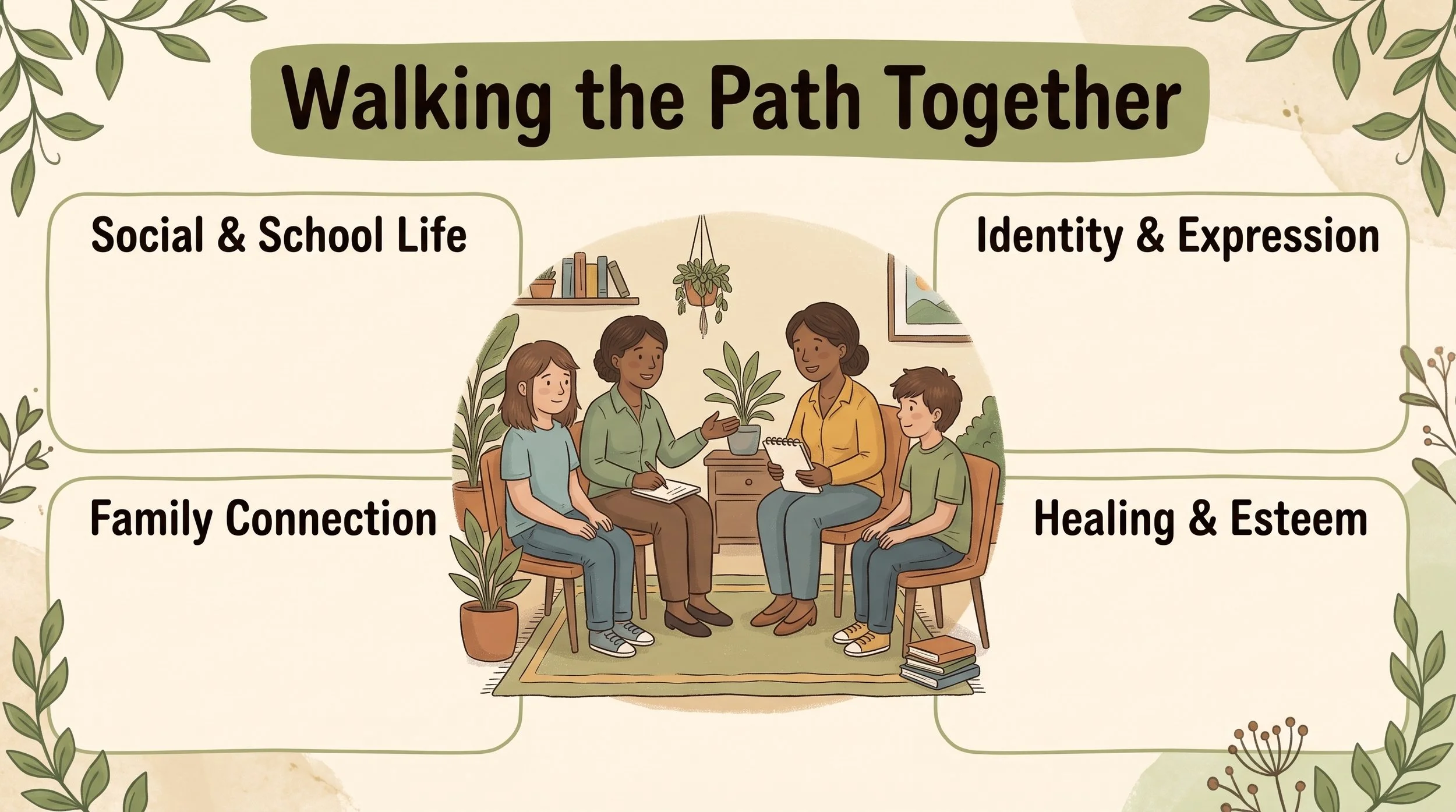
Walking the Path Together - School, Family, Identity, Healing & Esteem, with Dr Jo
1. Debriefing the Day-to-Day: Social, School, and Work Life
Transitioning—whether socially, medically, or both—does not happen in a vacuum. It happens in the schoolyard, in part-time jobs, and in social circles. For a young person, navigating pronouns, names, and the perceptions of peers can be exhausting.
Counseling provides a sanctuary to simply "debrief." It is a place to unpack the heavy backpack of microaggressions or celebrate the quiet victories of being seen correctly by a teacher or friend. By having a dedicated space to process these social interactions, young people build resilience and avoid internalizing the stress of their external environments. Multidisciplinary support, including educational counseling, is often essential to help youth thrive in these systems (Kozlowska et al., 2021).
2. Personal Identity and Gender Expression
Who are you, beyond what the world sees? Finding one's identity is a beautiful, ongoing process. In therapy, we remove the pressure of having to "figure it all out" immediately. We explore what gender means to the individual.
Sometimes this exploration is incredibly practical. We talk about clothing, haircuts, chest binding, or makeup. We discuss what feels safe, what feels joyful, and what feels like home in their own body. Therapy provides a sandbox for identity, where a child or youth can try on different aspects of personal presentation without judgment or rigid expectations.
3. The Family Circle: Navigating Dynamics and Relationships
When a child transitions, the family transitions too. Parents often carry a complex mix of fierce protective love, grief for the future they had imagined, and anxiety about the unknown. Siblings might feel confused or sidelined.
Our person-centered approach holds space for the whole family. We work through familial dynamics to ensure that parents are supported, which in turn makes them a stronger, more grounded anchor for their child. We know that family acceptance is one of the most significant protective factors for a trans child's mental health. Therapy helps bridge communication gaps, translating fear into understanding, and building a foundation of unconditional support.
4. Connections: Intimacy and Sexuality
As transgender youth grow into adolescence and young adulthood, questions about dating, intimacy, and sexuality naturally arise. This can be a particularly vulnerable area when navigating body dysphoria or the physical changes brought on by gender-affirming medical care.
Therapy offers a vital space to talk about healthy boundaries, navigating disclosure with potential partners, and exploring sexuality in a way that feels affirming and safe. A compassionate therapist helps youth recognize their inherent worth and realize they are deserving of loving, respectful relationships.
5. Nurturing Self-Esteem, Healing, and Dealing with Trauma
Unfortunately, many trans and gender-diverse youth carry the heavy burden of discrimination, bullying, or systemic trauma. These experiences can chip away at self-esteem and lead to significant psychological distress. Recent Australian research emphasizes that affirming a young person's gender legally, medically, and socially yields clear improvements in their mental health and wellbeing (Grant et al., 2024).
But affirmation alone doesn't instantly erase past hurts. This is where psychotherapeutic methods become invaluable. Rather than just offering a listening ear, we can use evidence-based frameworks—like Cognitive Behavioral Therapy (CBT), Narrative Therapy, or trauma-informed approaches like EMDR—to actively work through healing processes. These methods assist in processing traumatic events safely, reducing the sting of past bullying, and equipping youth with coping strategies that improve therapeutic outcomes more quickly.
Walking Forward
Gender-affirming care is never a "one size fits all" process. It is a highly individualized journey that requires flexibility, deep listening, and a lot of heart (Telfer et al., 2018). The WPATH and AUSPATH standards provide us with an excellent framework for what ethical, affirming care looks like. But it is within the quiet, person-centered moments in the therapy room—where a child finally feels safe enough to exhale—that the true healing begins.
If you are embarking on this path, please know that counselling is not a sign that something is "wrong" with your identity. It is simply a tool to help you navigate the world with a stronger, more resilient heart. We are here to walk with you.
In that there are many ways to pace and lead the therapy process over the years of a child’s and youth’s development toward adulthood. Our next paper will explore some of these options and give parents a bit of a practical touchpoint to reflect on the need for therapeutic support as well as a general type of roadmap to assist the costs and budget associated with counselling in transitions over time.
References
Coleman, E., Radix, A. E., Bouman, W. P., Brown, G. R., de Vries, A. L. C., Deutsch, M. B., Ettner, R., Fraser, L., Goodman, M., Green, J., Hancock, A. B., Johnson, T. W., Karasic, D. H., Knudson, G. A., Leibowitz, S. F., Meyer-Bahlburg, H. F. L., Monstrey, S. J., Motmans, J., Nahata, L., … Tishelman, A. C. (2022). Standards of Care for the Health of Transgender and Gender Diverse People, Version 8. International Journal of Transgender Health, 23(Supplement 1), S1–S259. https://doi.org/10.1080/26895269.2022.2100644 Cited by: 3878
Grant, R., Amos, N., Lin, A., Cook, T., Hill, A. O., Pang, K., Skinner, R. S., Carman, M., & Bourne, A. (2024). Mental health and wellbeing outcomes associated with social, medical, and legal gender affirmation among trans young people in Australia. International Journal of Transgender Health, 1–13. https://doi.org/10.1080/26895269.2024.2366881 Cited by: 29
Kozlowska, K., McClure, G., Chudleigh, C., Maguire, A. M., Gessler, D., Scher, S., & Ambler, G. R. (2021). Australian children and adolescents with gender dysphoria: Clinical presentations and challenges experienced by a multidisciplinary team and gender service. Human Systems: Therapy, Culture and Attachments, 1(1), 70–95. https://doi.org/10.1177/26344041211010777 Cited by: 78
Telfer, M. M., Tollit, M. A., Pace, C. C., & Pang, K. C. (2018). Australian standards of care and treatment guidelines for transgender and gender diverse children and adolescents. Medical Journal of Australia, 209(3), 132–136. https://doi.org/10.5694/mja17.01044 Cited by: 327