A Roadmap for Counselling Transgender Children and Youth
Pacing the Trans Journey: For Parents, Youth & Children
When families first step into a counselling space, they often carry a complex mix of profound love, protective instinct, and quiet exhaustion. In our previous piece, we explored how a deeply person-centred approach to counselling complements the medical and developmental pathways outlined in the WPATH Standards of Care (Coleman et al., 2022).
Now, it can be helpful to look at the practicalities of the therapeutic journey: what effective therapy looks like in the room, how pacing and frequency can be managed over time, and how best practice models focus on empowering the family to build lifelong resilience.
Often, parents wait until their child is around 8 to 10 years old before engaging a therapist. This "wait and see" period is a completely valid and natural part of the process. It allows parents to observe how their child grows into themselves and expresses their gender identity. At this age, children generally experience their gender very simply—it just is. They are primarily focused on playing, learning, and simply being kids.
The clinical heavy lifting during these early years often belongs to the parents, who are quietly carrying layers of anticipatory concerns and sometimes grief, the logistical anxieties of school and extended family, and questions about the future.
In best practice models, therapy is built entirely around aligning with parents and the family unit to hold this complexity, supporting the child by first supporting the ecosystem around them.
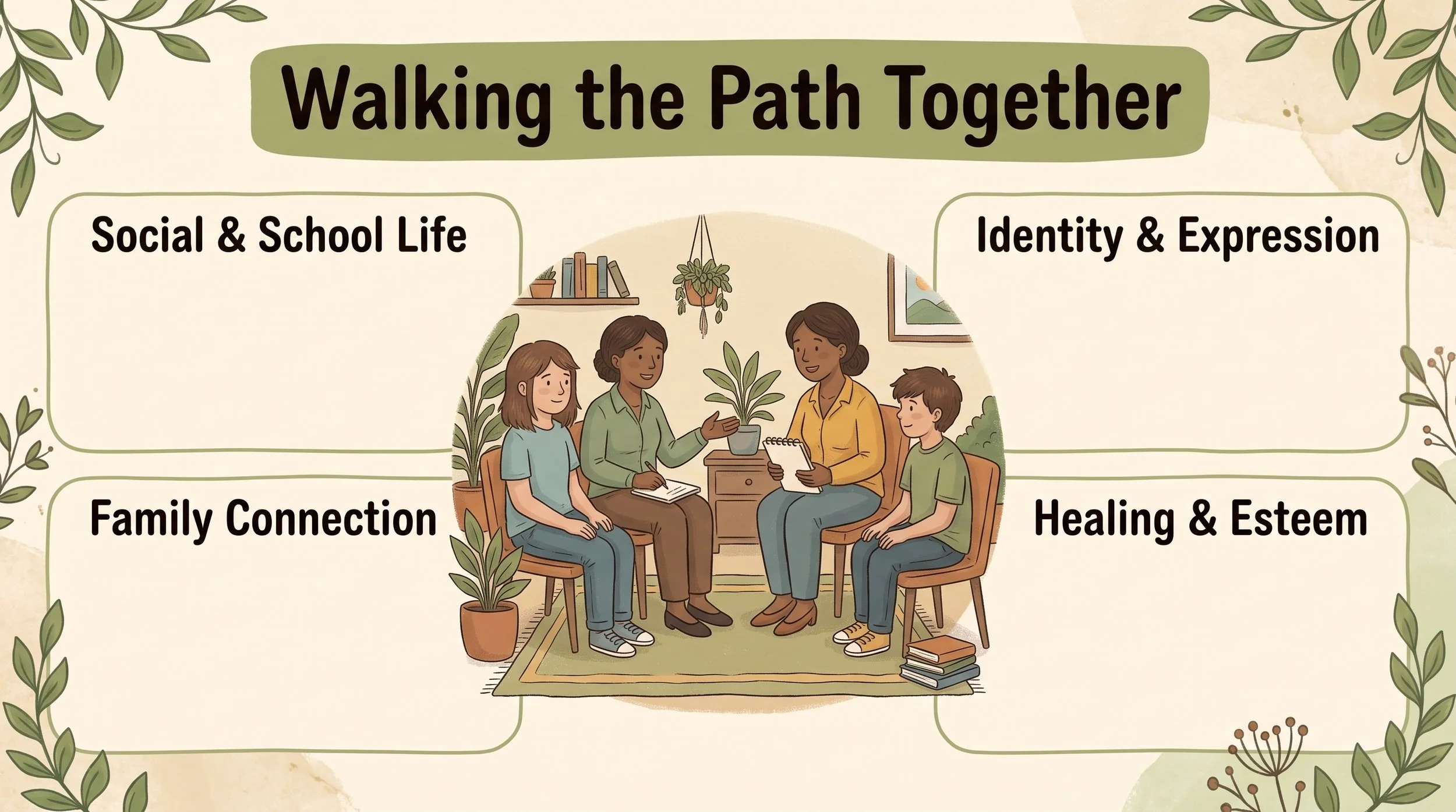
Walking the Path Together in Therapy and Life for Trans Youth and Children, with Dr Jo
Beyond Talk Therapy: Experiential, Practical, and Strength-Based Care
Counselling for gender-diverse youth does not necessarily mean sitting on a couch for years engaging only in traditional "talk therapy." Current best practice in this field is deeply person-centred and strength-based, but it is also highly practical and experiential.
Effective therapy often works with change-focused, measurable outcomes, seeking to provide co-created solutions that actively engage the young person in their own healing and growth processes.
To achieve this, experienced clinicians often draw upon a variety of dynamic, evidence-informed frameworks. For example, a well-rounded therapeutic approach might utilize a modified, holistic form of Cognitive Behavioural Therapy (CBT) that respectfully integrates culturally grounded approaches, alongside methods drawn from Neuro-Linguistic Psychotherapy and Ericksonian language frameworks.
Rather than just talking about problems, these experiential methods are designed to gently bypass traditional therapeutic roadblocks, helping young people build practical strategies for navigating common challenges like anxiety, self-esteem, bullying, and systemic trauma.
Most importantly, a hallmark of effective care is parent capacity building. Rather than making the family dependent on the therapist, the goal is to equip parents with the very therapeutic skills used in the session. By learning these frameworks, parents can engage therapeutically with their child at home in everyday moments.
This approach not only respects the family's time and budget, but ensures that as the child grows, the parents possess the tools to support them directly, fostering lifelong resilience and connection for the entire family.
Pacing Therapy: An Anchor, Not a Treadmill
There is a common misconception that engaging a therapist requires a commitment to weekly appointments for the foreseeable future. However, WPATH v8 principles clearly outline that childhood gender diversity is not a pathology.
If a child is socially affirmed, supported at home, and not experiencing acute distress (such as severe dysphoria or bullying), locking them into a rigid schedule of weekly therapy can inadvertently pathologise a perfectly healthy process of identity exploration.
Instead, contemporary models of care often recommend "stretching" engagement to bi-monthly or quarterly sessions during stable periods. This episodic approach de-pathologises the child, significantly reduces the financial and scheduling strain on parents, and keeps the counselling clinic as a trusted anchor.
When the developmental landscape naturally shifts—such as the onset of puberty or a change in schools—the therapeutic relationship is already warm, established, and ready to scale up to meet the new need.
The Parent’s Roadmap: When to Scale Therapy Up or Down
To help parents evaluate when to book a session or when to stretch the timeline, the following framework can serve as a practical touchpoint. It is designed to help families assess their child’s needs alongside their own capacity, offering a general roadmap for transitions over time.
1. Stable Exploration (Ages 8-10, affirmed, pre-puberty)
What the Child Might Experience: Living simply in their gender, focusing on friends, hobbies, and school.
What the Parent Might Experience: Background anxiety about the future, navigating extended family boundaries.
Suggested Pacing in Therapy: Quarterly check-ins. Primarily parent-focused for capacity building, skill transfer, and anticipatory guidance.
2. Approaching Puberty (Onset of physical changes)
What the Child Might Experience: Sudden increase in body dysphoria, anxiety, or withdrawal as the body changes.
What the Parent Might Experience: High distress, urgency to access paediatric endocrinology or medical navigation.
Suggested Pacing in Therapy: Fortnightly or Weekly. High-touch support required for both the child (coping skills) and the parent (decision-making and medical advocacy).
3. Systemic Transitions (Starting high school, moving towns)
What the Child Might Experience: Fear of being outed, negotiating new social rules, bullying, or pronoun fatigue.
What the Parent Might Experience: Advocating with school administration, managing the child's emotional dysregulation.
Suggested Pacing in Therapy: Short-term Weekly block (4-6 sessions). Focused on transition planning and practical goal-setting, then tapering back down as things settle.
4. Acute Mental Health Changes (Regardless of age)
What the Child Might Experience: Isolation, severe anxiety, school refusal, or depressive symptoms.
What the Parent Might Experience: Feeling overwhelmed, frightened for the child's wellbeing, exhausted.
Suggested Pacing in Therapy: Weekly. Immediate, consistent psychotherapeutic intervention focusing on stabilisation, safety, and active healing processes.
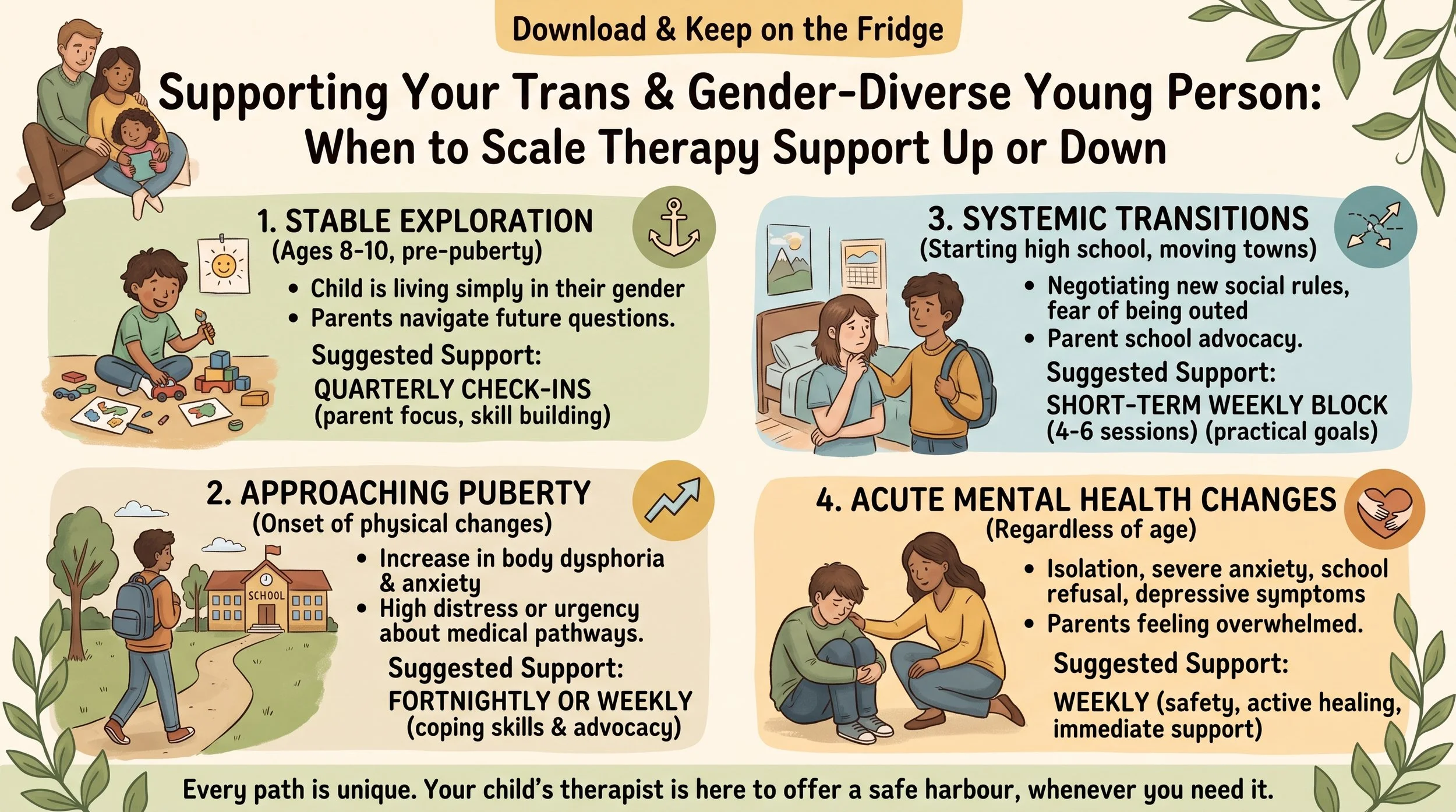
Trans Children Therapy Roadmap shown in four points, with ATS and Dr Jo
Ultimately, therapy is not meant to be a lifelong commitment to a waiting room. It is a dynamic resource intended to build your family's capacity, celebrate your child's inherent strengths, and provide you with the practical tools you need to thrive independently. As parents, you know your child best, and a skilled therapist is simply there to provide the roadmap, share the tools, and offer a safe harbour whenever the waters get rough.
References
Coleman, E., Radix, A. E., Bouman, W. P., Brown, G. R., de Vries, A. L. C., Deutsch, M. B., Ettner, R., Fraser, L., Goodman, M., Green, J., Hancock, A. B., Johnson, T. W., Karasic, D. H., Knudson, G. A., Leibowitz, S. F., Meyer-Bahlburg, H. F. L., Monstrey, S. J., Motmans, J., Nahata, L., … Tishelman, A. C. (2022). Standards of Care for the Health of Transgender and Gender Diverse People, Version 8. International Journal of Transgender Health, 23(Supplement 1), S1–S259. https://doi.org/10.1080/26895269.2022.2100644