Gay Men’s Health and Psychosexual Wellbeing: Review of Open-Access Literature
With Focus on Australia, New Zealand, Canada, and the United Kingdom (2020–2026)
By Jorandi Bowers PhD (aka Joseph Randolph), they/them
Abstract
Contemporary health and psychological literature frequently collapses cisgender adult gay men into broad epidemiological classifications—such as Men who have Sex with Men (MSM)—or broad demographic aggregates like LGBTIQ+. While useful for macro-level public health tracking, this aggregation obscures the unique psychological trajectories, developmental milestones, and relational dynamics of adult gay men.
This paper synthesises open-access research published between 2020 and 2026 across four Commonwealth jurisdictions: Australia, New Zealand (Aotearoa), Canada, and the United Kingdom (UK). It focuses specifically on disaggregated data examining adult gay men's mental health, intracommunity minority stress, post-PrEP psychosexual dynamics, and help-seeking behaviour within a strength-based counselling psychology framework.
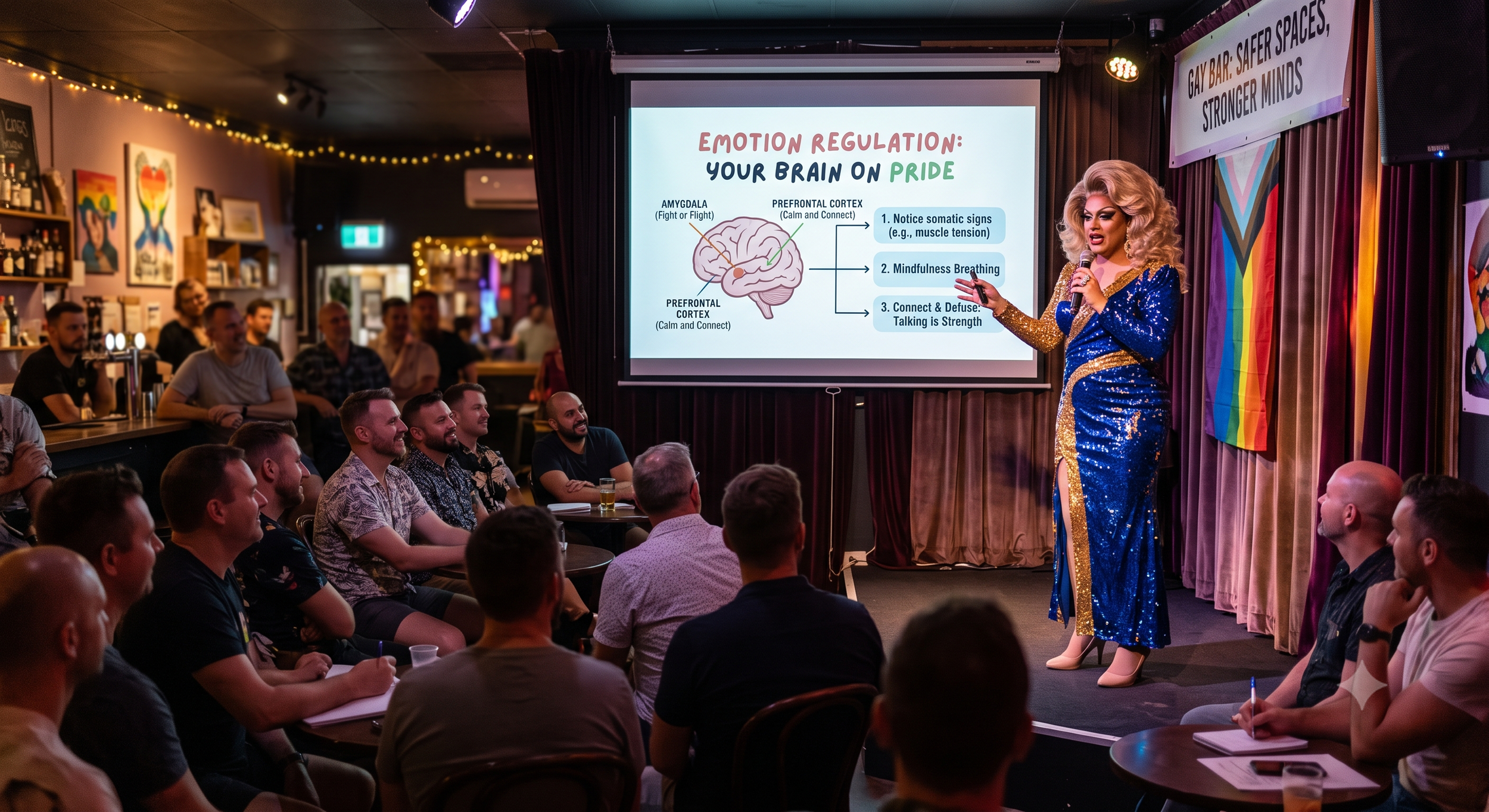
drag queen in gay bar presenting psychoeducational talk with slideshow
1. Introduction and Methodological Rationale
For decades, psychological research involving sexual minority men was dominated by two primary paradigms: the bio-medical HIV/STI risk framework, which coined the behavioral categorization "MSM," and broad social-policy research evaluating "LGBTIQ+" populations as a monolithic group.
Although "MSM" provided a functional epidemiological descriptor for public health tracking, it stripped away the cultural, relational, and affective dimensions of gay identity. Conversely, while "LGBTIQ+" surveys successfully capture macro-level discrimination, they often fail to isolate the distinct mental health vectors affecting cisgender adult gay men.
Between 2020 and 2026, open-access literature in counselling psychology and sexology marked a clear shift toward disaggregating these datasets.
Researchers increasingly recognize that adult gay men navigate specific developmental and intracommunity stressors that cannot be addressed through generic clinical interventions. This review synthesises recent disaggregated research across Australia, New Zealand, Canada, and the UK (the CANZUK nations), offering an empirical foundation for evidence-based, affirmative clinical practice.
2. Intracommunity Minority Stress and Erotic Capital
Traditional minority stress theory emphasizes the psychological impact of external heterosexist discrimination (Meyer, 2003). However, recent open-access literature across Australia and Canada highlights that adult gay men experience significant psychological distress generated within gay male cultural environments.
2.1 Body Image, Muscularity Dysmorphia, and Erotic Hierarchies
Quantitative and qualitative studies disaggregating gay male samples from broader sexual minority groups demonstrate elevated rates of body dissatisfaction, objectification, and muscularity anxiety (Parent et al., 2021; Filice et al., 2023).
Within commercial scene spaces and location-based dating applications, gay men navigate rigid "erotic hierarchies" that assign value based on body composition, youth, and traditional physical indicators of masculinity. This environment fosters elevated rates of body dysmorphic concerns and disordered eating behaviors relative to heterosexual counterparts.
Practice Insights:
As a therapist and member of the community, body image and internalisation of sub cultural scripts among gay men is huge once gay men come out and during the process of identity formation and across the lifespan.
Prevalent. And ever present - from the ways we script identity to the ways we present bodies and engage in social activities. But then there are some gay men who intentionally sit outside of the more dominant subcultural frameworks - who for example may engage in steam punk vs traditional queer identity frames, or who align with rural and regional Australian cultural mindsets for dress and presentation vs urban gay culture.
In any case, the trajectory is that diversity lends itself to individuality regardless your scene - and every cultural and personal expression is valued and highly regarded.
That said, yes there is a mismatch between the materialism of the body as object versus the internal growth and identity of self as subject leaning toward the trajectory of more seasoned depth and enduring wisdom.
Staying in the dominant subcultural matrix can sometimes limit one’s overall growth potentials - yet the true irony always remains. Gay subculture is a window to expansive personal growth and awareness of self in relation to these often intentionally chosen material and performance scripts. The key, honey, is to wake the hell up and take the scripts as just that - pathways and playthings that help AND hinder your growth.
When body is a problem like with dysmorphia - we have a serious personal trend over time that effects our well being in so many ways. Vital to face this gently but firmly. Even more important - to share the narrative of our experiences. To shift that story to our advantage and make the most of embodiment. This means doing the hard yards of self-exploration, discovery, self-intimacy, and when we are really really lucky to share this path with others in intimate personal and physical ways.
Eating disorderly habits are worth their own special little window. When we look through the looking glass, we might see we are not always the fairest dame of all in the land of Oz. But surely, Sir Mirror provides potent insights and reflects our reality to some degree.
That said, we need a moment to pause and take heed of how food choices relate to so many lifestyle health and lifestyle medicine considerations - that the key is actually becoming a bit more conscious. That is it really. Awareness is the key - once we become more aware of what we put into body, and how we feel and relate to body, we begin to value self in new ways. Food can become empowering - an alley on the journey.
2.2 Femmephobia and Internalized Stigma
Research evaluating gender expression among adult gay men highlights how internalised heteronormativity often manifests as "femmephobia"—the devaluation or active rejection of effeminate traits in oneself or potential romantic partners (Sankey et al., 2021). Clinical trials indicate that gay men who experience rigid pressures to conform to hyper-masculine standards report higher levels of social anxiety, intimacy avoidance, and psychological distress.
Practice Insights:
Well, this is awkward. Laugh out loud. In our experience, we suppose that the hyper masculine script in gay subculture was and remains a kind of performance - both an anxiety and a comic commentary on the whole male edifice in western cultures. We sometimes forget that many gay men are not yet detached enough from these scripts to realise that they are indeed scripts that we can take on and leave behind.
When you seriously identify with these values, you ARE THAT. But when you step away and get some distance, you ARE MORE THAN THAT. Do you get what I mean? This is an experience. It is not an idea.
I guess our study of sociology of health helped us to realise that not only homophobia was not internal to my identity, but gay subcultural values were not internal to my being a person. Thus, practicing mindfulness and active meditation practice made me aware of being more than what we feel, see, think - it is all secondary to a much more robust and strong spiritual identity that is in some basic way detached from all of the social scripts.
Years of therapy then makes this even more clear. This gives us ways to cope with social anxiety, loneliness, isolation, fear and negative emotions, avoiding of intimacy, sexuality issues that muck up our sense of self, and many layers of distress mentally that hinder our basic sense of peace.
All the struggles exist. But how we cope is changed by taking the journey. Making that enduring commitment to self growth - and to practicing daily strategies that build the ecology of presence, capacity to be present, and to enjoy and celebrate sensate awareness, embodiment, and natural beauty in self, others and the environment.
2.3 Aging, Loneliness, and Community Exclusion
In Australia, disaggregated sub-analyses of national surveys such as Private Lives 3 demonstrate a distinct "loneliness spike" among gay men over 45 years of age (Hill et al., 2020). Unlike heterosexual adults, who frequently transition into traditional family units, older gay men rely heavily on chosen family and peer networks. When commercial spaces cater predominantly to youth and physical perfection, older gay men face elevated risks of social isolation, ageism, and exclusion from community safety nets (Loughnan et al., 2022).
Practice Insights:
Yes this is very true - older gay men in urban settings in particular report this issue. This seems to be the same over the past decades as well, like gay subculture is stuck on youth performance and body perfect worship. For those of us who move on, the dominant focus of the urban culture is a bit old, sorry.
Maybe living in regional (and some would say remote) Australia gives us country gay men a different view. The stereotypes of the country and provincial aside, from our view in the margins there is a kind of reality check in the Australian bush. We realise that life is not easy, and that there is more to life than image and dress, body and abs. There is more that is about work, lifestyle, community - beyond the subculture. We are forced in rural and regional areas to integrate more into the broader communities around us because there is really little other choice.
These experiences can be difficult, but can also create a more actively diverse experience of culture and this reflects, perhaps, another kind of resilience where identity is more about who I am with others outside of my subgroup. Every one of these insights is variable. Your story may be radically different. We would hope that as we grow older, especially when we lose our life partner(s) and/or major health issues arise, we might have some links to support and when we are really blessed, a special friend or two who understands and supports us during our elder years.
3. Relational Architecture and the Post-PrEP Psychosexual Landscape
The introduction and widespread implementation of Pre-Exposure Prophylaxis (PrEP) over the past decade drastically reduced HIV transmission rates across CANZUK nations. However, psychological literature from 2020 to 2026 highlights the complex psychosexual adjustments following this medical transition.
Practice Insight:
For those who might not know, PrEP (Pre-Exposure Prophylaxis) is a prescription medicine taken by HIV-negative people to prevent them from contracting HIV before potential exposure. When taken daily as a pill or given as an injection, it builds up in the body to block the virus from taking hold, reducing the risk of HIV infection by up to 99%.
Over the past decade, the widespread adoption and distribution of PrEP medications (such as Truvada, Descovy, and long-acting injectables like Apretude) have fundamentally shifted public health. Because at-risk individuals can safely protect themselves, communities with high PrEP coverage have experienced significant, measurable drops (some studies report up to a 38% decrease) in new HIV diagnoses.
It acts as a primary layer of defense against transmission, working alongside other safe-sex practices and routine medical care to drastically curb the spread of the virus.
3.1 Unlearning Somatic Hypervigilance
For generations, gay men’s sexual socialization was bound up with the trauma of the HIV/AIDS epidemic and persistent fear of infection. Open-access clinical literature indicates that despite biomedical safety under PrEP, many adult gay men exhibit persistent somatic hypervigilance, performance anxiety, and conditioned guilt surrounding sexual pleasure (Prestage et al., 2021; Grace et al., 2022). Contemporary sex therapy protocols focus on helping gay men transition from fear-based risk mitigation to pleasure literacy and emotional intimacy.
Practice Insight:
As we advance in senior experience in our fields of practice, we are amazed that everything seems to change yet remain basically the same. These issues for gay men were prevalent in the 1990s. They are still today. The journey is still right in front of us - do we take it up? Do we do the work that is necessary? This is the choice it seem, then and now.
3.2 Consensual Non-Monogamy (CNM) and Dyadic Satisfaction
Disaggregated relational studies consistently show that adult gay male couples utilize open and non-monogamous relationship structures at higher rates than heterosexual or lesbian couples (Mogilski et al., 2022; Vilkin & Davila, 2023).
Crucially, 2020–2026 literature proves that consensual non-monogamy is not correlated with poor relationship quality or attachment insecurity. Relationship satisfaction in open gay relationships is predicted by:
Clear, explicit negotiation of boundary agreements.
Open communication regarding jealousy and compersion.
Dyadic trust and mutual emotional investment.
Therapeutic interventions that assume monogamy as the default benchmark of relationship success risk pathologising viable, mutually satisfying relational configurations.
Practice Insights:
For those who may not know, ‘compersion’ is the empathetic feeling of joy or happiness experienced when a partner finds joy or love with someone else. Often described as the "opposite of jealousy," it is a foundational concept in the consensual non-monogamy (CNM) and polyamory communities, though it can apply to any relationship.
The insights on non-monogamy are fascinating. A professor in the late 80s pointed out that ‘the only form of monogamy that actually exists is serial monogamy.’ He was suggesting that the myth of a monogamous society was false. That true monogamy is rarer than people were willing to admit - because even when couples settle into a life long monogamous relationship the majority of people over their lifespan are not actually monogamous. It is rare that couples meet in youth and marry and stay monogamous for their lifetimes.
Thus, he pointed out that separation and divorce function as a pathway to serial monogamy, as well as couples who periodically ‘fall of the wagon’ but who re-engage monogamy over time, which if anything is the more actual reality in most societies.
Again it seems that gay subculture is leading the way with the trouple vs couple phenomena as well as other forms of non-monogamous relationships such as open commitments.
4. Clinical Implications for Counselling Psychology
Open-access health-seeking data across Australia indicates that adult gay men exhibit significantly higher rates of psychological help-seeking compared to heterosexual men (Hill et al., 2020). However, service retention drops sharply when clinicians exhibit subtle forms of incompetence or bias:
Diagnostic Overshadowing: Inadvertently attributing general mental health presentations (e.g., career burnout or generalized anxiety) solely to the client's sexual orientation.
Heteronormative Relational Assumptions: Expecting monogamy or traditional courtship steps as necessary indicators of relationship stability.
Misunderstanding Gay Male Cultural Contexts: Lack of familiarity with location-based dating apps, non-traditional kinship networks, or contemporary sexual terms.
Practice Insights:
Our PhD research raised these concerns in 2002. They appear to be ongoing. Go figure.
4.1 Recommended Practice Guidelines
Adopt a Strength-Based, Affirmative Lens: Re-frame gay male relational forms and sexual autonomy as adaptive strengths rather than moral or clinical deficits.
Integrate Intracommunity Stress Audits: Assess for body image anxiety, ageism, and internalised femmephobia during intake assessments.
Normalize Consensual Non-Monogamy: Develop competency in helping couples establish clear, collaborative relational agreements without imposing monogamous assumptions.
Practice Insights:
Ditto. With intentionally raised eye brows, and maybe a touch of eye liner.
References
Filice, E., Meyer, S. B., & Moola, F. J. (2023). Body image, dysmorphia, and muscle dissatisfaction among gay and bisexual men: A qualitative meta-synthesis. Psychology of Sexual Orientation and Gender Diversity, 10(2), 189–204.
Grace, D., Stewart, M., & Lachowsky, N. J. (2022). Gay, bisexual, and queer men's mental health and sexual well-being in the post-PrEP era: A Canadian qualitative study. BMC Public Health, 22(1), Article 812.
Hill, A. O., Bourne, A., McNair, R., Carman, M., & Lyons, A. (2020). Private Lives 3: The health and wellbeing of LGBTIQ people in Australia (ARCSHS Monograph Series No. 122). Australian Research Centre in Sex, Health and Society, La Trobe University.
Loughnan, S. A., Hughes, A. K., & Frank, C. (2022). Social isolation, loneliness, and health-related quality of life among older gay men in Australia. Journal of Applied Gerontology, 41(5), 1210–1219.
Meyer, I. H. (2003). Prejudice, social stress, and mental health in lesbian, gay, and bisexual populations: Conceptual issues and research evidence. Psychological Bulletin, 129(5), 674–697.
Mogilski, J. K., Mitchell, V. E., Reeve, S. H., & Hamilton, L. D. (2022). Multi-partnering and relationship quality: Maintaining consensual non-monogamy across diverse sexual orientation groups. Archives of Sexual Behavior, 51(3), 1601–1618.
Parent, M. C., Bradstreet, T. C., & Wille, L. (2021). Body image and health behaviors among adult gay men: The mediating role of intracommunity minority stress. Journal of Counseling Psychology, 68(4), 412–423.
Prestage, G., Hammoud, M. A., Jin, F., & Bavinton, B. (2021). Changing sexual culture and psychosexual dynamics among Australian gay men using PrEP. Sexual Health, 18(3), 245–253.
Sankey, C., Harrison, R., & Riva, G. (2021). Femmephobia, internalised homophobia, and psychological well-being among cisgender gay men in the UK. Journal of Homosexuality, 68(9), 1488–1508.
Vilkin, A. J., & Davila, J. (2023). Consensual non-monogamy relationship agreements, communication, and relationship satisfaction among sexual minority couples. Journal of Sex & Marital Therapy, 49(2), 175–191.