Through the eyes of Autism
By Dwayne Wannamarra Kennedy PhD (he, him)
Imagine… You are not yourself… You are a person with Autism… What does it feel like to see, feel, hear, and touch in this way?
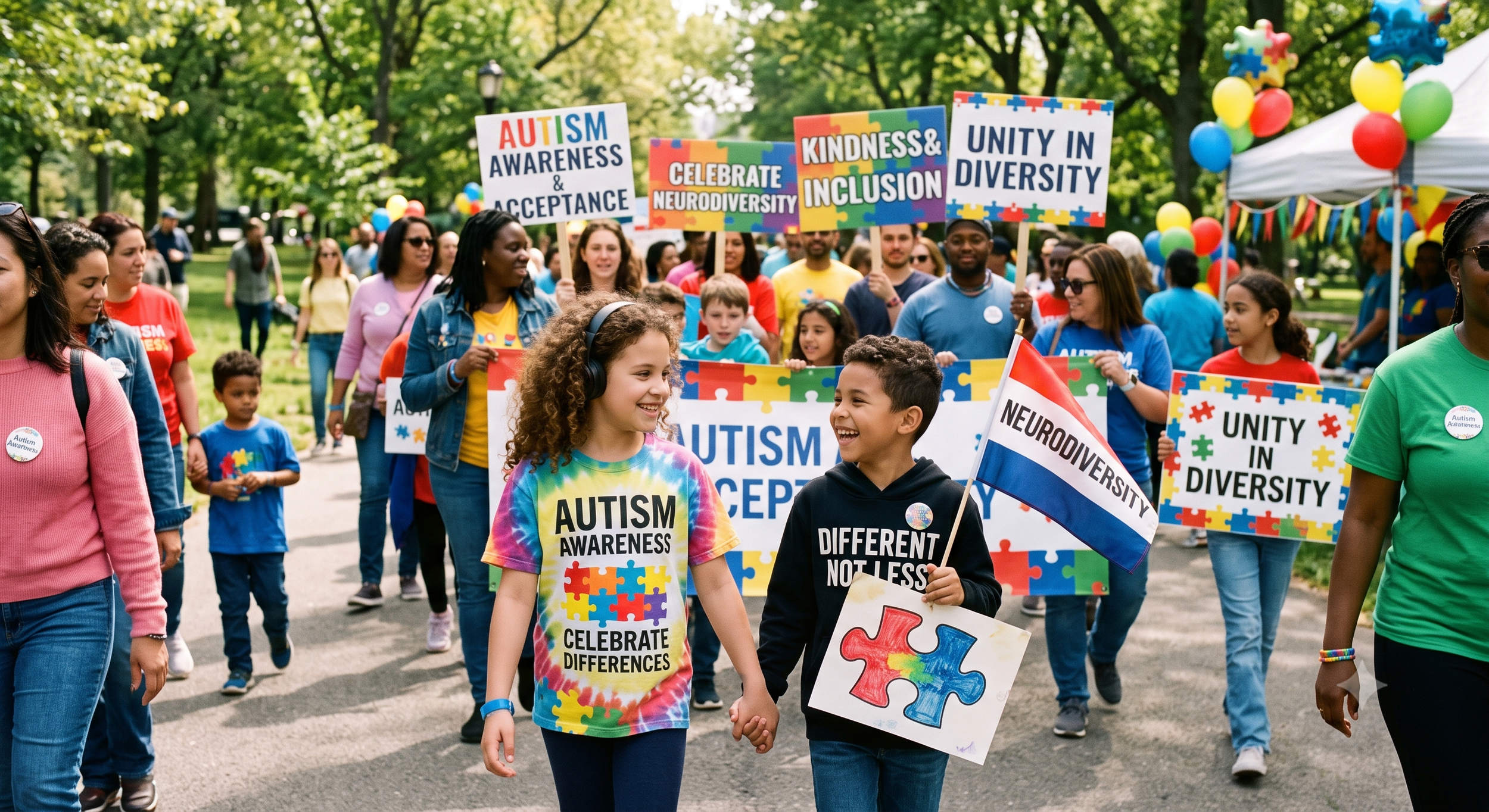
People marching in autism awareness parade with colourful signs
I see, act, think, engage, react and have social skills that seem to be different from you.
My eyes, thoughts, hearing, taste and even my coordination are different from the neuro-typical way of being.
I may even be seen as rigid, obsessive, in my interactions, activities and behaviours.
You may even see me flapping my arms, hitting my forehead, my face, spinning and radically moving around. “You may see behaviours which are seen as not normal”.
Such as, having a fascination with objects like keys, tearing up paper, playing with water and making verbal sounds. This may be seen as a fixation, hyper-focused and may appear as cognitive inflexibility. This may even appear to you as obsessive-compulsive or even seen as a ritual that I need to complete.
It has taken me many years to adjust to this neurotypical world and I have to adjust to changes in my life everyday, due to this alien world.
I appreciate it when you give me time, routine, patience, understanding, empathy and kindness so that I am able to move more freely with you within your world; this is how you build a rapport with me. I hold this close and I learn from you, as you are my teacher as much as I am yours.
Generally speaking, many neurotypical thinking individuals have not taken the time to visit my worldview. For me, I have had to learn, engage, challenge myself, try to understand and even hide from your world, to look like that I fit in. In saying this, I will shed light and give you an insight into my world.
When you speak harsh words my ears hurt.
When your tone gets loud I have what is called a sensory overload.
Your body language may change to aggressively pointing at me, I am now overwhelmed.
I need to disengage and withdraw.
Your behaviours have changed towards me.
I feel overwhelmed and I can not make sense of what is happening.
I now have to take time to process this and it can be very difficult for me.
As I have what you see as abnormalities, in how I respond behaviourally, I have what you see as deficits in language, both receptive and expressive.
These are all affected by my cognitive functioning and are seen as deficits “aberrant attention”.
This means that I will take longer to understand, process, articulate my thoughts, and feelings and you will see a change in my behaviours. It may take me hours, days or even weeks to come to an understanding of what has happened or is happening.
This is where you can support me - please - to overcome and self-regulate but before this happens.
You may see me displaying behaviours which look socially unacceptable like hitting, biting, throwing, kicking, even if my attention has changed.
You will note impulsivity, overactivity and hyperactivity has taken over.
Instead, step in, guide me so that I have ways of letting my frustrations out.
You may need to provide me with time to wind down, a safe space, someone I can trust, another activity.
Once this has happened I may be able to have a conversation with you, slow down your conversation.
Speak clearly and precisely.
Don't give me to much to think about.
Just provide time, acceptance and understanding this is where my learning will grow.
I am differently abled from you. This is in fact a gift, not a curse. Please - stop looking at me as a diagnosis.
My life is unique. I am also a human being on this planet. That we are different can be a blessing.
And being different can be a path to understanding and healing.
About the Author
Dr Dwayne, or Dr Dee as he is called by some clients, has a PhD in Counselling Psychotherapy. His work within Autism awareness and dis-ability advocacy is life-long. He started as a teenager - and advanced over the years into support worker roles, team leader, manager, then into therapy training, psycho-education, counselling, and now he is a senior therapist with many years of experience.
Dwayne is well known for his deep compassion, empathy, and sensitivity to people’s embodied stories. To their pain and suffering - he responds with a healing calm that is sometimes uncanny. He has a deep intuition and sense of people, and is known for providing a space to explore self in safe and creative ways.
His books are open at the time of this post for both NDIS funded work and for private cases - and if you wish to connect please use the contact form on the home page.