The 16-to-18 Runway: Here we go!
Dr Jo Bowers PhD
Turning eighteen is universally celebrated as a gateway to independence.
Yet, for parents and carers of young people with complex neurodevelopmental or cognitive vulnerabilities, this milestone is often accompanied by a quiet, profound sense of panic.
While a child’s biological and psychological development operates on a gradual continuum, the law operates as a sudden switch. Overnight, the legal framework that protected your child dissolves, replaced by adult systems that assume full autonomous capacity.
In our practice, we see the fallout of families attempting to navigate this cliff-edge in the weeks leading up to an 18th birthday. It is simply too late. Best practice dictates that transition planning must begin at age sixteen. This "16-to-18 runway" is a critical window to get legal, financial, and clinical frameworks securely in place before the biological clock forces the system’s hand (Foley et al., 2012).
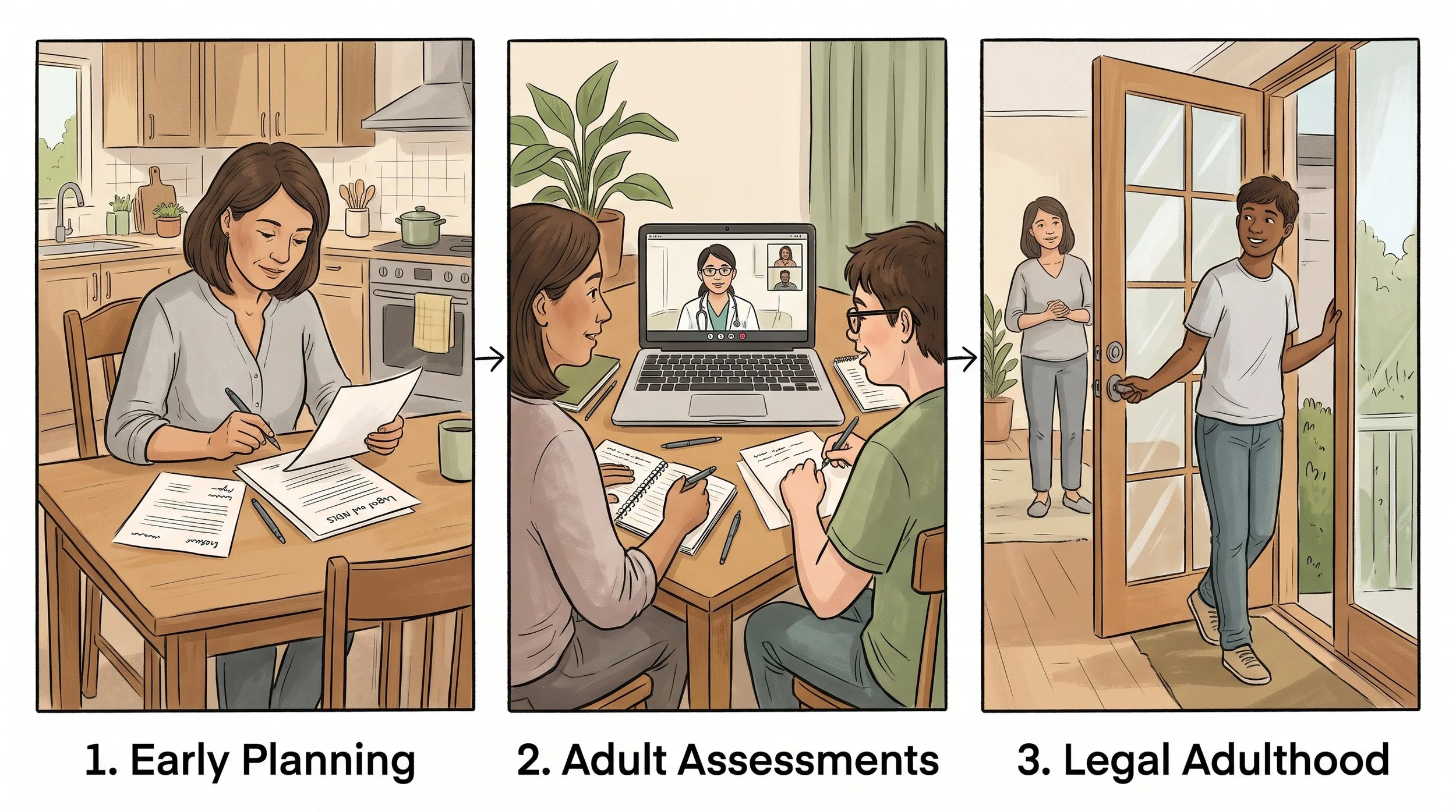
A storyboard image showing the major transitions toward legal adulthood for NDIS participants
The Legal Threshold: Capacity, Vulnerability, and Guardianship
Under Australian law, an individual legally becomes an adult at 18. At this exact moment, parents cease to be automatic legal decision-makers. The adult system assumes that the 18-year-old possesses the capacity to sign contracts, consent to medical procedures, and manage their own finances (Guardianship Act 1987).
For young adults with severe intellectual disabilities or complex mental health profiles, this overnight assumption of capacity creates immense vulnerability to exploitation and harm.
The 16-to-18 runway is when families must begin having difficult, proactive conversations about formalising support. This often involves applying to state tribunals for formal Guardianship or Financial Management orders, or establishing a Power of Attorney.
These legal steps do not exist to strip a young person of their rights; rather, they are protective mechanisms that legally empower parents or trusted advocates to continue safeguarding the young adult in a system that no longer recognises the default "parental" role (Carney, 2012).
Intersecting Systems: The Matrix of Adulthood
The transition to adulthood extends far beyond the National Disability Insurance Scheme (NDIS). At 18, a young person ages out of paediatric health systems and transitions into adult medical and psychiatric care, which often requires re-establishing historical evidence with entirely new specialists.
For vulnerable youth, this age also marks the exit from Out-of-Home Care (foster systems) or youth justice frameworks. The sudden withdrawal of these state-based supports creates a perilous transition point where young people are at severe risk of falling through systemic cracks (Mendes, Snow and Baidawi, 2014).
A collaborative practitioner works across this entire ecological matrix, ensuring that intersecting systems are mapped and continuity of care is established before the 18th birthday arrives.
The NDIS Reset: Nominees and Adult Funding
Within the NDIS, turning 18 triggers an automatic systemic reset. If a parent has not been formally registered as an "NDIS Nominee" prior to this birthday, the NDIA may legally cease communicating with the parent regarding the participant's funding or plan.
Furthermore, the funding model fundamentally shifts. The NDIS will no longer accept justifications based on "paediatric early intervention."
Support must pivot toward adult-specific funding categories. Families must strategically secure Dedicated Capacity Building for adult life skills (such as community access and emotional regulation) and Flexible Core Supports to prevent the devastating skill regression that frequently occurs post-school (Heslop et al., 2002).
Functional Assessments: The Core of Transition Planning
Because the systemic requirements shift so drastically, clinical evidence must also evolve. Functional Behaviour Assessments (FBAs) are central to measuring a young person’s needs prior to age 18. These exhaustive clinical assessments provide the foundational proof required by Guardianship tribunals, state health systems, and the NDIS to justify the necessity of ongoing, comprehensive adult support.
During this runway period, the Behaviour Support Plan (BSP) must be entirely re-written. A paediatric BSP focused on at home support for a child or classroom integration and playground dynamics is useless to an 18-year-old.
The adult BSP must address profound, mature issues: independent living risks, community navigation, vulnerability to coercion, and the right to safely explore adult relationships and sexuality (Gore et al., 2013).
The Shifting Definition of Restrictive Practices
Perhaps the most complex, and often overlooked, aspect of the 18th birthday is the radical legal shift regarding Restrictive Practices.
When a child is 12, locking the front door at night so they do not wander onto the street, monitoring their internet access, or withholding their pocket money so they don't buy unsafe items is considered standard parental duty of care under family law. However, the moment that individual turns 18, they are legally protected by adult human rights frameworks, including the UN Convention on the Rights of Persons with Disabilities (United Nations, 2006).
Overnight, those exact same parental actions legally transform into Regulated Restrictive Practices (RRPs)—environmental restraints and financial coercion. They legally become a deprivation of an adult’s liberty. During the 16-to-18 runway, parents and providers must radically reconsider how the young person is supported.
Everyday household rules must be clinically reviewed, translated into the language of human rights, and, if they are still required for the adult's safety, formally justified and regulated within the new adult Behaviour Support Plan (Commonwealth of Australia, 2018).
A Guided Transition
The threshold of adulthood should be a time of celebration, not an administrative cliff edge that pushes families to the brink of burnout. Navigating guardianship, redefining restrictive practices, and securing adult funding are immense tasks, but they do not have to be faced alone.
By beginning this work early on the 16-to-18 runway, we collaborate with families to carry the heavy clinical and administrative load. We ensure the adult evidence base is watertight, allowing parents to step back from the bureaucratic frontline and simply celebrate the incredible milestone of their child stepping into adulthood.
References
Carney, T., 2012. 'Guardianship, social citizenship and the theorising of mental health law', Medical Law Review, 20(3), pp. 300-323.
Commonwealth of Australia, 2018. National Disability Insurance Scheme (Restrictive Practices and Behaviour Support) Rules 2018. Canberra: Federal Register of Legislation.
Foley, K.R., Dyke, P., Girdler, S., Bourke, J. and Leonard, H., 2012. 'Young adults with intellectual disability transitioning from school to post-school: A literature review framed within the ICF', Disability and Rehabilitation, 34(20), pp. 1747-1764.
Gore, N.J., McGill, P., Toogood, S., Allen, D., Hughes, J.C., Baker, P., Hastings, R.P., Noone, S.J. and Denne, L.D., 2013. 'Positive Behaviour Support in the UK: A state of the nation report', International Journal of Positive Behavioural Support, 3(1), pp. 13-37.
Guardianship Act 1987 (NSW). Sydney: NSW Legislation.
Heslop, P., Mallett, R., Simons, K. and Ward, L., 2002. Bridging the Divide at Transition: What Happens for Young People with Learning Difficulties and their Families? Kidderminster: BILD Publications.
Mendes, P., Snow, P. and Baidawi, S., 2014. 'The views of service providers on the challenges facing young people also involved in the youth justice system transitioning from out-of-home care', Journal of Youth Studies, 17(6), pp. 773-786.
United Nations (UN), 2006. Convention on the Rights of Persons with Disabilities. Treaty Series, 2515, p. 3.
Dr Joseph R Bowers is a PhD in Counselling Psychotherapy and a Senior Specialist Behaviour Support Practitioner who is registered with the NDIS Commission. He has worked full time in behaviour support services since 2011, then under ADHC NSW and with the transition into NDIS Dr Bowers founded Ability Therapy Specialists Pty Ltd to continue offering tailored person centred and international standards of best practice to rural, regional and remote Australians. As a telehealth service, ATS reaches people where they need help - in the home and in your hand via your favourite application for video and audio chats and discussions. Contact us via the form on the home page - scroll down and flip us a note.