Neurodivergent Insights
By Dwayne Wannamarra Kennedy PhD, (he~him)
This paper analyzes a foundational first-person narrative of an autistic individual navigating a predominantly neurotypical world. By contextualizing terms like "aberrant attention," "cognitive inflexibility," and "sensory overload," this paper bridges the gap between subjective lived experience and objective clinical frameworks. It provides actionable strategies for three distinct environments: the corporate workplace, relationship counselling, and clinical/academic research, emphasizing a shift from a deficit-based model to a neurodiversity-affirming paradigm.
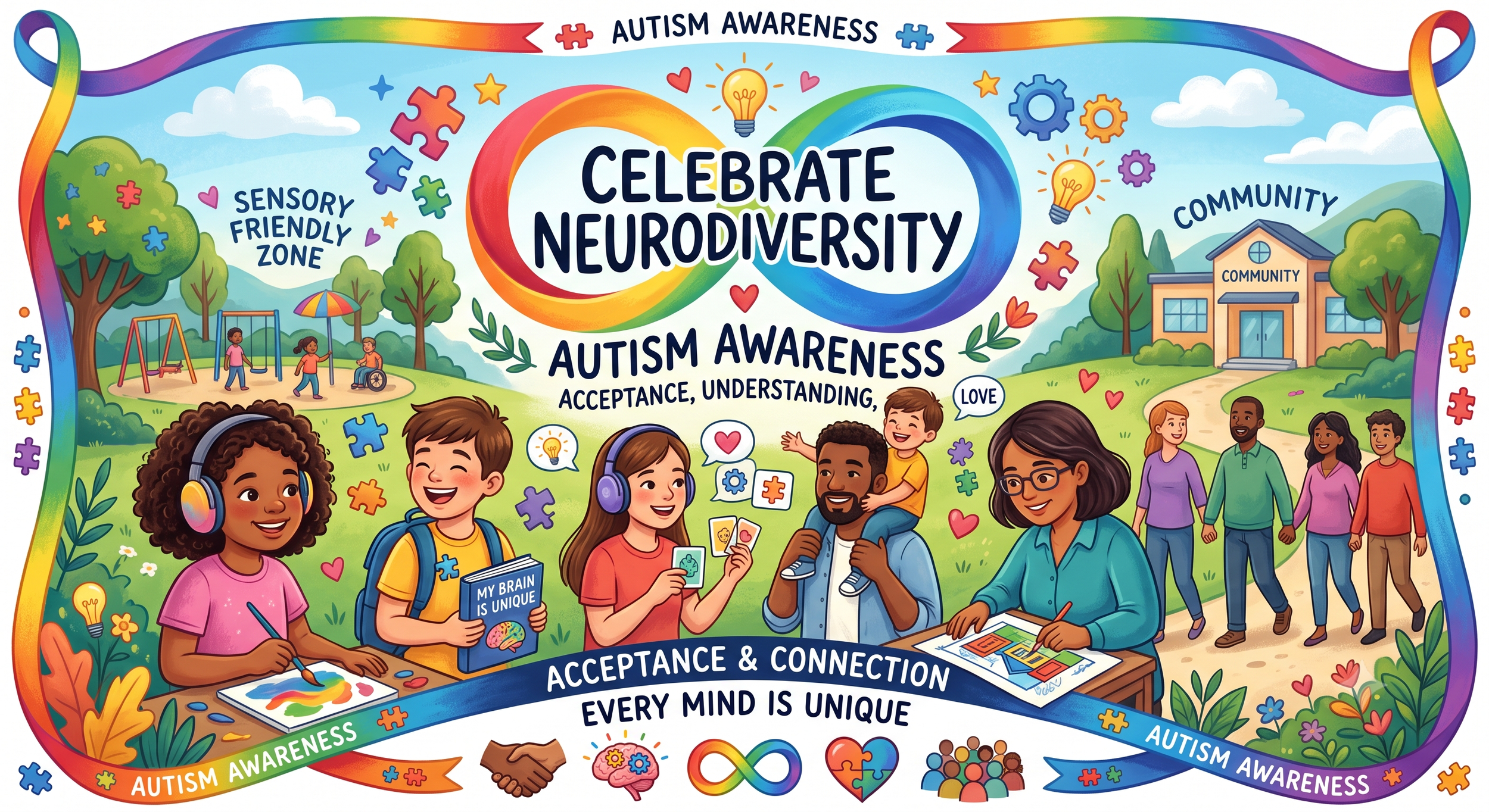
celebrate neurodiversity and autism awareness banner with children and adults in colourful cartoon settings
The Source Narrative:
I see, act, think, engage, react and have social skills that seem to be different from you.
My eyes, thoughts, hearing, taste and even my coordination are different from the neuro-typical way of being.
I may even be seen as rigid, obsessive, in my interactions, activities and behaviours.
You may even see me flapping my arms, hitting my forehead, my face, spinning and radically moving around. “You may see behaviours which are seen as not normal”.
Such as, having a fascination with objects like keys, tearing up paper, playing with water and making verbal sounds. This may be seen as a fixation, hyper-focused and may appear as cognitive inflexibility. This may even appear to you as obsessive-compulsive or even seen as a ritual that I need to complete.
It has taken me many years to adjust to this neurotypical world and I have to adjust to changes in my life everyday, due to this alien world.
I appreciate it when you give me time, routine, patience, understanding, empathy and kindness so that I am able to move more freely with you within your world; this is how you build a rapport with me. I hold this close and I learn from you, as you are my teacher as much as I am yours.
Generally speaking, many neurotypical thinking individuals have not taken the time to visit my worldview. For me, I have had to learn, engage, challenge myself, try to understand and even hide from your world, to look like that I fit in. In saying this, I will shed light and give you an insight into my world.
When you speak harsh words my ears hurt.
When your tone gets loud I have what is called a sensory overload.
Your body language may change to aggressively pointing at me, I am now overwhelmed.
I need to disengage and withdraw.
Your behaviours have changed towards me.
I feel overwhelmed and I can not make sense of what is happening.
I now have to take time to process this and it can be very difficult for me.
As I have what you see as abnormalities, in how I respond behaviourally, I have what you see as deficits in language, both receptive and expressive.
These are all affected by my cognitive functioning and are seen as deficits “aberrant attention”.
This means that I will take longer to understand, process, articulate my thoughts, and feelings and you will see a change in my behaviours. It may take me hours, days or even weeks to come to an understanding of what has happened or is happening.
This is where you can support me - please - to overcome and self-regulate but before this happens.
You may see me displaying behaviours which look socially unacceptable like hitting, biting, throwing, kicking, even if my attention has changed.
You will note impulsivity, overactivity and hyperactivity has taken over.
Instead, step in, guide me so that I have ways of letting my frustrations out.
You may need to provide me with time to wind down, a safe space, someone I can trust, another activity.
Once this has happened I may be able to have a conversation with you, slow down your conversation.
Speak clearly and precisely.
Don't give me to much to think about.
Just provide time, acceptance and understanding this is where my learning will grow.
I am differently abled from you. This is in fact a gift, not a curse. Please - stop looking at me as a diagnosis.
My life is unique. I am also a human being on this planet. That we are different can be a blessing.
And being different can be a path to understanding and healing.
The Analysis of the Narrative:
1. Introduction and Thematic Analysis
The source narrative highlights a profound reality: autistic individuals spend a lifetime adapting to a "neurotypical way of being," often at the cost of cognitive fatigue and social masking (hiding traits to blend in).
When neurotypical environments fail to accommodate these differences, it can lead to acute dysregulation. The text identifies three core domains of divergence:
Sensory and Perceptual Processing: Differences in hearing, taste, and somatic coordination.
Cognitive and Attentional Mechanisms: Unique profiles in processing time, focus, and transitions.
Behavioral Adaptations (Stimming): Self-regulatory behaviors (e.g., arm-flapping, spinning, object fixation) frequently mischaracterized as pathology.
2. Clinical and Academic Contextualization
To understand the narrative through a research-validated lens, several key concepts must be defined:
Sensory Overload and Allostatic Load: The text notes that "harsh words" and "loud tones" cause physical pain and cognitive disengagement. In clinical terms, this is sensory overstimulation caused by atypical sensory gating. Over time, navigating these environments increases allostatic load—the cumulative wear and tear on the body and brain due to chronic stress.
"Aberrant Attention" and Monotropism: The narrative references "aberrant attention." In modern cognitive science, this is better understood through Monotropism Theory (Murray et al., 2005). Autistic attention tends to be monotropic (pulling resources intensely into a single "interest tunnel"). When disrupted abruptly, it causes significant cognitive friction.
The Double Empathy Problem: The author notes that neurotypicals rarely visit their worldview. This directly illustrates sociologist Damian Milton’s (2012) Double Empathy Problem, which posits that communication breakdowns between autistic and neurotypical individuals are bidirectional—caused by a mutual lack of understanding, rather than a unilateral deficit in the autistic person.
Delayed Processing and Executive Functioning: The text highlights that processing emotional or social events can take "hours, days, or even weeks." This reflects differences in executive functioning and neurological integration time, rather than an intellectual or linguistic deficit.
3. Cross-Disciplinary Applications
3.1 Corporate Workplaces & Human Resources
In a corporate setting, misunderstood autistic traits are often misconstrued as insubordination, rigidity, or poor performance.
We have three categories: 1Perceived Behavior, 2 Neurological Root, and 3 Workplace Accommodation
Follow the category number in the three examples below.
1 "Rigidity" or "Inflexibility" | 2 Deep reliance on predictability to manage cognitive load. | 3 Provide clear agendas, written workflows, advanced notice of structural changes.
1 Withdrawal and Disengagement | 2 Sensory or social overload; processing delay. | 3 Allow asynchronous communication (Slack/Email) instead of demanding instant verbal answers in meetings.
1 "Fixation" / Hyper-focus | 2 Monotropic attention profile. | 3 Channel into specialized roles requiring deep focus, data analysis, or uninterrupted problem-solving.
Corporate Takeaway: Workplaces and in homes others who are neurotypical need to shift performance metrics from "social presentation" to "functional output." We need to create low-sensory workspaces, target communications, and pacing of timing plus to support alternative forms of communication, including remote work options, all to prevent sensory burnout.
Sensory burnout can happen in hours, days, and is more than likely cumulative. Once the pattern is set, it is harder to understand and correct. Assumptions are lethal - they erode trust and compromise safety.
They key take away is that behavioural support is not a clinical need per se - it is in fact a social workplace and functional necessity. Behaviour support is practical.
Under funded NDIS constraints, clinical behaviour support was turned into a highly specialist advanced practice focused through diagnosis and treatment models. This model might have usefulness in highly complex cases, but the clinical emphasis and funding gatekeeping can be counterproductive in more holistic and ecological humanitarian environments.
For non-NDIS people, behaviour support can be a vital pathway to understanding social dynamics and personal strengths. Even with NDIS participants, we are seeing a shift away from formal behavioural support funding toward applying generic behavioural support within other forms of therapy - including among occupational therapy, and with counselling and other forms of helping.
As the NDIS is focused still on functional capacity and skill building, these applications of behaviour support more broadly are entirely appropriate. They are shown to build skills and capacities in the short and longer term, and lead to higher levels of independence and well being.
3.2 Relationship and Marriage Counseling
The narrative explicitly calls out how communication breakdowns occur when a partner's tone becomes aggressive or loud, leading to a complete shutdown ("I need to disengage and withdraw").
De-escalating the Nervous System: Counsellors must teach neuro-distinct couples that when an autistic partner withdraws, it is not "stonewalling" (Gottman's defensive tactic). It is a neurological necessity for self-regulation.
The "Slow Down" Protocol: In alignment with the text ("slow down your conversation, speak clearly"), couples should implement a structured pause during conflicts. Give the autistic partner time to process the emotional data without demanding an immediate behavioral or verbal response.
Mutual Teaching: Validate the narrative's assertion: "You are my teacher as much as I am yours." Therapy should focus on co-creating a shared dialect rather than forcing the autistic partner to adopt neurotypical communication norms.
3.3 Clinical and Academic Research
For researchers and clinicians, this narrative serves as a qualitative case study on the dangers of relying solely on external behavioral observations (DSM−5 criteria) without assessing internal autonomic states.
Redefining "Challenging Behaviors": Externalized distress behaviors (hitting, throwing, kicking) mentioned in the text are not behavioral non-compliance; they are acute catastrophic reactions to a system pushed past its failure point (autistic meltdown).
Intervention Timing: The text notes that learning can only happen after regulation has occurred in a safe space. Clinicians must prioritize down-regulation of the nervous system over behavioral modification (e.g., ABA principles) during moments of distress.
4. Conclusion: The Path to Mutual Understanding
Rapport and understanding is built through patience, structural routine, and empathy. True inclusion requires neurotypical systems—whether an enterprise corporation, a romantic partner, or a clinical institution—to step into the autistic worldview rather than continuously demanding that the autistic individual mask their true self to fit in.
This key insight governs most of our work in cases of Autism support. It is not about changing the person with Autism. It is rather about changing the perspectives and behaviours of family, staff, colleagues, and co-workers to adapt their approaches and expectations. This is so true that when parents or staff refuse to change their perspective and their behaviours toward the person with Autism, we have sometimes concluded that as specialists we cannot help people because they choose to remain focused on Autism as a diagnosis that needs a cure, which is, quite frankly, not a helpful or wise conclusion.
From our view, Autism is like being left handed. It is part of a person’s make up - it is integral to their brain chemistry and neurological pathways. Expecting the person to change to fit in with a neurotypical mindset is akin to prejudice and discrimination. In many situations this approach is potentially damaging and harmful. As harsh as this sounds, it needs to be plainly stated - as neurotypical people and people with Autism often circle around these issues without wanting to ‘hit the nail on the head’ or ‘bite the bullet.’
Once you understand Autism, you realise it is not a psychopathology. It is a form of disability when Autism is to such a degree that it impairs functional capacity and participation in society - yes. But, Autism is also part of the very nature of a person’s capacities and identity. Whether this is consious or not conscious it is necessary to respect Autism as an innate identity and personal characteristic.
References
Gernsbacher, M. A., & Stevenson, J. L. (2016). Was Autism Always This Common? Current Directions in Psychological Science, 25(3), 190-195. (Contextualizing the shift in how autism is diagnosed and understood).
Milton, D. E. (2012). On the ontology of autistic impairment: Challenging the imitation of autistic character. Disability & Society, 27(6), 883-887. (Establishing the Double Empathy Problem referenced in Section 2).
Murray, D., Lesser, M., & Lawson, W. (2005). Attention, monotropism and the diagnostic criteria for autism. Autism, 9(2), 139-156. (Validating the processing and "hyper-focus" dynamics noted in the narrative).
Porges, S. W. (2011). The Polyvagal Theory: Neurophysiological Foundations of Emotions, Attachment, Communication, and Self-regulation. W. W. Norton & Company. (Explaining the physiological shift from sensory overload to fight/flight/freeze behaviors like throwing or withdrawing).
Dwayne Kennedy PhD is a senior counselling psychotherapist with many years experience in specialist behaviour support and in Autism support. His books are open at the time of this post for private and NDIS funded work. To connect, see the form on the home page.