The Evolving Landscape of Autism Support (2020–2025): Neurological Mechanisms, Applied Interventions, and the Paradigm Shift in Level 2 Care
Coloured circles on white background with the letters A U T I S M on small square blocks.
Editor’s Note
This post comes from our study of Autism - by way of wanting to review the literature up to the end of 2025. When I was researching, my interests were to review findings on state of the art support and therapy for behavioural support. Because many of our cases tend to be ASD Level 2, Requiring Substantial Support, this was my choice of focus for this particular moment.
This is an in-depth post. It may take about 30-40 minutes to read once, and you will find yourself needing to read it at least two times. While that is a big time investment, you will not find this level of information in many places. Our work in these lengthy posts is to provide a curated summary of high quality and value.
Like our work with clients, we tend to be comprehensive when necessary and when useful to the person’s support needs and funding reviews. I hope you find this information useful and helpful. To our Australian readers, I apologise for the spelling and terminology - the international nature of the research as well as the dominant voice appears to have an American tone. I gave a thot to changing/editing the paper once we had the first draft completed, and simply do not have the time before Christmas this year.
We appreciate this paper - because the science confirms much of our clinical experience and moves our understanding further due to the significant insights from recent scientific findings. We suspect that with the dawn of AI post 2025, the next 2-5 years will see significant advances in our understanding Autism from medical, psychotherapeutic, and disability support perspectives.
A word of caution - this paper is NOT clinical advice at all. People are advised to seek your behaviour specialist, occupational therapist, or medical doctor for treatment specific questions. This paper is in fact an exploration of the literature to gain insights about new advances in high level clinical perspectives. In fact, many of the insights here are more relevant to American contexts for example, the paper highlights certain treatment shifts in the USA.
Our primary audience is Australian - and this paper’s weakness is that it does not translate and discuss implications to the Australian context. That said, sharing this paper rather than holding it back for 3-4 months to write more seemed the most practical. It is up to therapists, doctors, and specialists to take this information and explore implications and treatment options in local contexts.
For parents and people with Autism, copy the URL of this page and share this with your GP or therapist. Ask them to read the information, and to provide you with practical advice. Rely on your GP and your specialist therapist input - do not rely on anything you read here. The pace of change and what is most relevant or current is shifting very quickly - get your advice from your GP and the therapist specialists they recommend.
- Dr Jorandi (Joseph Randolph) Bowers PhD
1. Introduction: The State of Autism Research and Practice in 2025
The half-decade between 2020 and 2025 represents a seminal epoch in the history of autism research, characterized by a fundamental decoupling of "pathology" from "identity" and a simultaneous explosion in mechanistic biological understanding. As the prevalence of Autism Spectrum Disorder (ASD) in the United States has risen to approximately 1 in 31 children as of 2025—a figure that demands robust public health and educational responses—the scientific community has moved beyond merely describing symptoms to elucidating the neural circuitries that drive them.1
For individuals classified as requiring "Level 2" support (Substantial Support Needs), this era has been transformative. Historically, this demographic—often characterized by marked deficits in verbal and nonverbal social communication skills, social impairments apparent even with supports in place, and limited initiation of social interactions—occupied a precarious middle ground. They were often too "complex" for light-touch interventions yet possessed potential for autonomy that was frequently stifled by the heavy-handed custodial models used for Level 3 populations.3 The research of 2025 has corrected this imbalance, offering targeted, dignity-affirming, and biologically grounded strategies specifically for those with substantial support needs.
The convergence of molecular neuroscience and social science has yielded a dualistic progression. On one front, the "Medical Model" has achieved unprecedented granularity, identifying specific thalamocortical gating failures and synaptic pruning deficits that explain sensory overwhelm with physiological precision.4 On the other, the "Social Model" and the neurodiversity movement have reshaped clinical ethics, forcing a departure from compliance-based therapies toward those that prioritize regulation, autonomy, and mental health.6
This paper synthesizes the exhaustive body of literature from 2020 through late 2025, providing a comprehensive analysis of the neurological underpinnings of emotional regulation, the efficacy of Naturalistic Developmental Behavioral Interventions (NDBI), the critical role of the Low Arousal Approach, and the emerging technological landscape supporting executive function. It serves as a roadmap for clinicians, researchers, and families navigating the complex terrain of substantial support needs in 2025.
1.1 Prevalence, Demographics, and the Identification Gap
The epidemiology of autism has shifted dramatically. The Centers for Disease Control and Prevention (CDC) reported in April 2025 that the prevalence of ASD had reached 3.2% (1 in 31) of 8-year-old children, a sharp increase from 1 in 36 just two years prior.1 This rise is not merely a statistical artifact of better counting; it reflects a broadening of diagnostic criteria and improved identification in historically underserved communities.
However, disparities persist. While identification has improved, the "diagnosis age" remains stagnant at an average of 4 years, despite the American Academy of Pediatrics recommending screening at 18 and 24 months.7 This delay is critical for Level 2 support, as early intervention windows for establishing communication systems are often missed. Furthermore, the 2025 data indicates that while 1 in 3 children with autism also has an intellectual disability, the specific needs of the "Level 2" cohort—who may have average IQ but severe adaptive functioning deficits—are often obscured in aggregate data.2
1.2 The Autism Data Science Initiative (ADSI)
Recognizing the complexity of these demographic shifts, the National Institutes of Health (NIH) launched the Autism Data Science Initiative (ADSI) in late 2024. This $100 million endeavor utilizes advanced machine learning and "exposome-wide" analyses to disentangle the gene-environment interactions contributing to the rising prevalence.1 Unlike previous genomic studies that sought a "smoking gun," ADSI focuses on heterogeneity, attempting to map specific biological subtypes (biotypes) to specific support needs. This initiative represents a move toward "precision medicine" in autism, where a child’s specific neural connectivity profile could eventually dictate whether they receive sensory integration therapy, pharmaceutical support, or intensive communication coaching.
2. Neurological Frontiers: Brain Function, Connectivity, and Emotional Regulation
The interval from 2020 to 2025 has been pivotal in moving beyond descriptive neuroanatomy to mechanistic understandings of autistic brain function. The "black box" of the autistic brain—particularly regarding why sensory inputs often lead to catastrophic emotional dysregulation—has been illuminated by breakthrough findings in thalamic gating and synaptic architecture. These findings are not merely academic; they provide the physiological rationale for the "Low Arousal" and "Sensory Safety" therapeutic approaches discussed later in this report.
2.1 The Reticular Thalamic Nucleus: The Gatekeeper of Consciousness
One of the most consequential findings of 2025 is the identification of the Reticular Thalamic Nucleus (RT) as a primary driver of sensory and behavioral anomalies in autism. Research conducted at Stanford Medicine and published in Science Advances (August 2025) has elucidated that hyperactivity in the RT—a shell-like structure acting as a "gatekeeper" for sensory information—can drive behaviors traditionally associated with autism, such as social withdrawal and repetitive movements.4
2.1.1 The "Leaky Thalamus" Hypothesis and Sensory Gating
The thalamus serves as the central relay station for sensory information (visual, auditory, tactile) traveling from the periphery to the cortex. It is the brain's mixing board. The RT, composed largely of inhibitory GABAergic neurons, regulates this flow. In neurotypical functioning, the RT inhibits or "gates" irrelevant background noise (e.g., the hum of an air conditioner, the feeling of a tag on a shirt), allowing the cortex to focus on salient information.
The 2025 findings, utilizing the Cntnap2 knockout mouse model (a robust genetic model for autism), revealed that the RT in autistic brains exhibits hyperexcitability and burst firing.12 This hyperexcitability paradoxically disrupts the gating mechanism. Instead of smoothly filtering stimuli, the RT functions erratically, potentially allowing an overwhelming flood of sensory data to reach the cortex—a phenomenon termed the "leaky thalamus" hypothesis.14
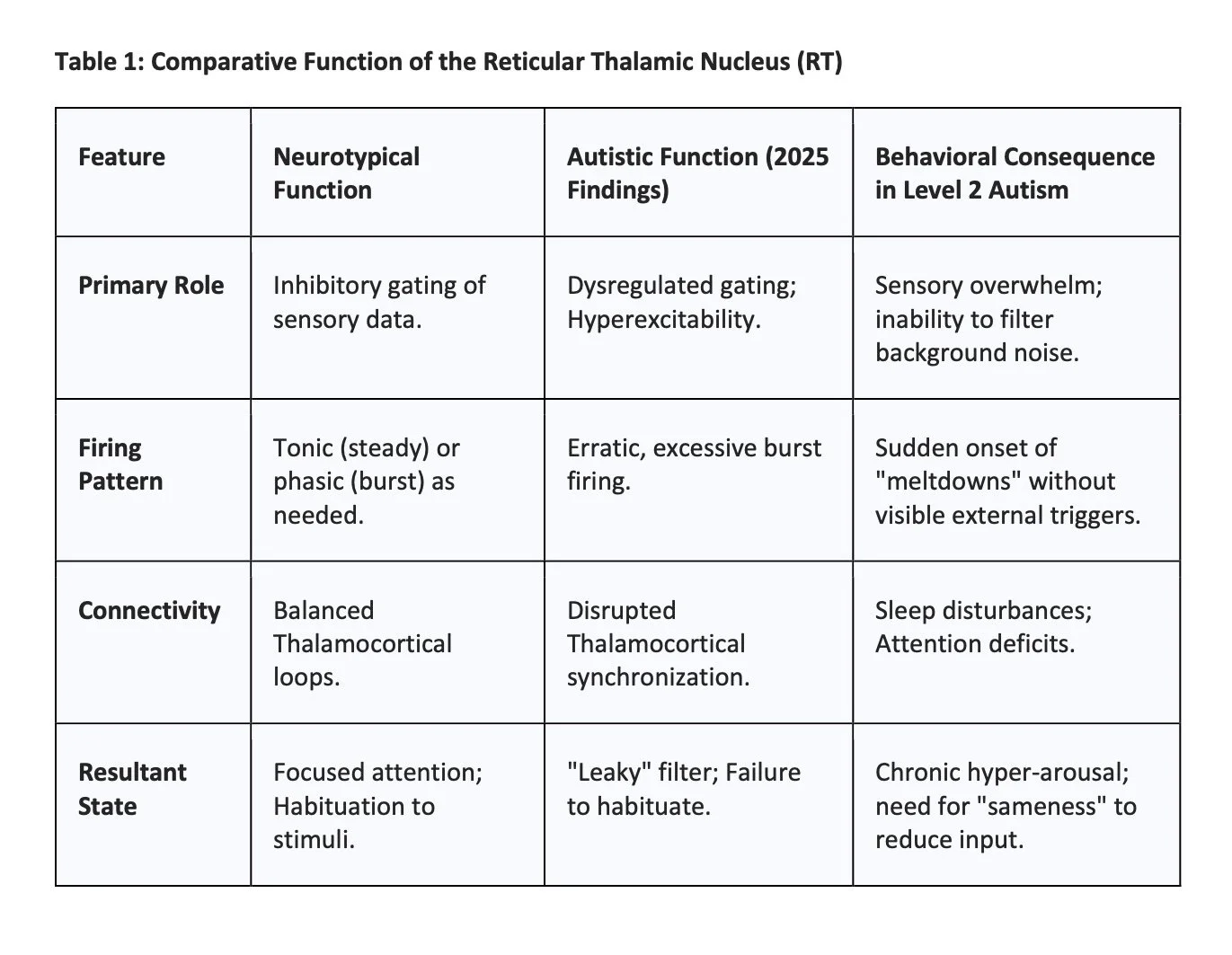
For an individual with Level 2 autism, this means the brain is literally besieged by unfiltered sensory data. The behavioral output—covering ears, humming, or retreating—is not "non-compliance" but a physiological necessity to manage cortical saturation.
2.1.2 Causal Links and Therapeutic Implications
The causal link established in the Stanford study is robust. Researchers utilized chemogenetics (DREADDs) to manipulate the RT. When they suppressed the hyperactivity of the RT using a specific drug (Z944, a T-type calcium channel blocker), they observed a reversal of autism-like behaviors. The mice showed improved social interactions and reduced repetitive behaviors.4 Conversely, stimulating the RT in neurotypical mice induced autism-like behaviors.
This finding overlaps significantly with epilepsy research. Epilepsy is present in approximately 30% of autistic individuals compared to 1% of the general population.9 The shared mechanism of thalamic hyperexcitability suggests that drugs targeting these specific calcium channels could serve dual purposes: managing seizures and reducing the painful intensity of sensory processing disorders in autistic populations.
2.2 Synaptic Density and the Hyper-Connectivity Theory
Parallel to the functional findings in the thalamus, structural imaging studies in 2024 and 2025 have solidified the theory of altered synaptic pruning. A landmark study utilizing Positron Emission Tomography (PET) scans with the radiotracer 11C-UCB-J allowed researchers to visualize synaptic density in living brains for the first time, moving beyond post-mortem analysis.5
2.2.1 The Pruning Deficit
During typical development, the brain produces an excess of synapses in early childhood, which are subsequently "pruned" during adolescence to increase efficiency and signal clarity. The 2025 data indicates that autistic brains retain a significantly higher density of synapses. In some cortical regions, the reduction in synapses during adolescence was found to be only 16% in autistic brains, compared to the typical 50% drop observed in neurotypical controls.15
This finding challenges the older "under-connectivity" theories. The autistic brain is likely hyper-connected at the local level. While this density might theoretically support enhanced memory or attention to detail (strengths often seen in Level 2 autism), it creates a "noisy" neural environment.16
2.2.2 Functional Implications of Hyper-Connectivity
The retention of excess synapses correlates with the "Intense World Theory" of autism. A brain with too many connections may process specific stimuli with excruciating intensity but struggle to integrate information across distant brain regions (long-range under-connectivity).
Monotropism: The hyper-connected local networks may explain "monotropism," the tendency to have a singular, intense focus. The neural hardware is wired to lock onto one stream of information deeply, making "task switching" (which requires disengaging that robust local network) metabolically expensive and emotionally distressing.17
Sensory Amplification: Combined with the RT dysfunction, high synaptic density ensures that once sensory data breaches the thalamic gate, it is amplified by the dense cortical networks, leading to rapid overstimulation.
2.3 Neural Circuits of Emotional Regulation
Emotional dysregulation—rapid shifts in mood, prolonged distress, and difficulty returning to baseline—is a core challenge for individuals with substantial support needs. Research through 2025 has mapped these challenges to specific disconnects between the Prefrontal Cortex (PFC) and the Limbic System.
2.3.1 The Prefrontal-Amygdala Disconnect
Functional MRI (fMRI) studies involving cognitive reappraisal tasks—where participants are asked to "reframe" a negative image to reduce their emotional response—have shown distinct activation patterns in autistic adults.
Neurotypical Response: Regulation involves increased activation of the Dorsolateral Prefrontal Cortex (DLPFC), which sends inhibitory signals to the Amygdala (fear center) and Nucleus Accumbens (reward/emotion center), effectively "cooling down" the reaction.
Autistic Response: The 2025 studies found that while autistic participants understood the task, their brains showed significantly less modulation of the Amygdala and Nucleus Accumbens by the PFC.18
This suggests a mechanistic decoupling: the "top-down" regulatory commands from the PFC do not effectively reach or influence the "bottom-up" emotional centers. This provides a physiological basis for why cognitive strategies (e.g., "Tell yourself it's okay," "Count to ten") are often ineffective for Level 2 autistic individuals during moments of high arousal. The neural pathway required for logic to soothe emotion is functionally impaired.
2.3.2 Structural Variations: Amygdala and Hippocampus
Structural analyses have further nuanced our understanding of the "social brain." While earlier studies offered conflicting data on amygdala size, 2025 consensus points toward developmental trajectories where the amygdala is often enlarged in early childhood (linked to anxiety and over-responsivity) and remains structurally distinct in adulthood.16 Furthermore, the hippocampus, critical for memory, is often enlarged. This may explain the intense, specific memories associated with special interests or, conversely, the deep encoding of traumatic sensory events (e.g., a specific loud fire alarm) that can trigger phobic responses years later.16
2.4 Interoception and the Insular Cortex
A critical area of research that bridges neurology and therapy is Interoception—the sensing of internal bodily states (hunger, heart rate, bladder fullness, pain). The Insular Cortex (Insula) is the primary hub for interoception. Research indicates that autistic individuals often show hypo-activity or aberrant connectivity in the right Anterior Insula (rAI) and its interaction with the Default Mode Network (DMN).20
2.4.1 The Mechanism of Alexithymia
This insular dysfunction provides the neurological mechanism for Alexithymia (difficulty identifying and describing emotions), which affects approximately 50% of the autistic population. If the brain does not accurately process the physiological signals of an emotion (e.g., recognizing a racing heart as "anxiety" or a growling stomach as "hunger"), the individual cannot label the state or engage in regulation until the physical sensation becomes overwhelming.
Implication for Level 2 Support: Behaviors labeled as "sudden aggression" are often the result of unrecognized internal pain or hunger that the individual could not feel until it reached a threshold of agony. The "Interoceptive Discrimination Difficulty" is a primary target for modern therapeutic interventions.21
3. The Paradigm Shift: Neurodiversity-Affirming Practice in 2025
The period from 2020 to 2025 has witnessed a decisive ethical and clinical pivot. The "Medical Model," which views autism as a set of deficits to be cured or normalized, has been largely superseded in research and progressive practice by the "Neurodiversity Paradigm." This shift is particularly critical for Level 2 support, where the intensity of intervention previously led to restrictive or compliance-based practices that are now recognized as harmful.
3.1 From Compliance to Autonomy
Traditional behavioral approaches often prioritized "compliance"—teaching a child to follow directions immediately, maintain "quiet hands," or suppress stimming (self-stimulatory behavior). By 2025, a significant body of literature, including guidelines from professional bodies like the American Occupational Therapy Association (AOTA), has re-evaluated these goals.6
3.1.1 The Trauma of "Quiet Hands" and Masking
Research into Autistic Burnout has identified "masking" (the suppression of autistic traits to fit in) as a primary contributor to mental health crises, depression, and suicidality in autistic adults.24 Interventions that enforce "quiet hands" or forced eye contact are now understood to increase cognitive load and anxiety, thereby reducing the capacity for genuine learning or social connection.
The 2025 Consensus: Stimming is a necessary regulatory mechanism. Suppressing it deprives the individual of a tool to manage the "leaky thalamus" discussed in Section 2.
Clinical Shift: Therapists are now trained to distinguish between harmful behaviors (self-injury) and autistic behaviors (flapping, rocking). The latter are to be respected and protected.17
3.2 The Double Empathy Problem
The Double Empathy Problem, a theory proposed by Dr. Damian Milton, has gained robust empirical support through 2024-2025. It posits that communication breakdowns between autistic and non-autistic people are mutual, not solely the fault of the autistic person.
Research Findings: Studies show that autistic people communicate effectively with other autistic people; the transfer of information is accurate and rapport is high. The "deficit" only appears in mixed neurotype interactions.17
Impact on Therapy: This shifts the burden of intervention. Instead of solely training the autistic individual to mimic neurotypical social skills, interventions now focus on "two-way" understanding. Families, teachers, and peers are trained to interpret autistic communication styles (e.g., infodumping, echolalia, avoidance of eye contact) as valid and meaningful.25
3.3 Neuro-Affirming Goal Setting
In 2025, clinical goals for substantial support needs have moved away from "normalization" toward "quality of life" and "self-determination."
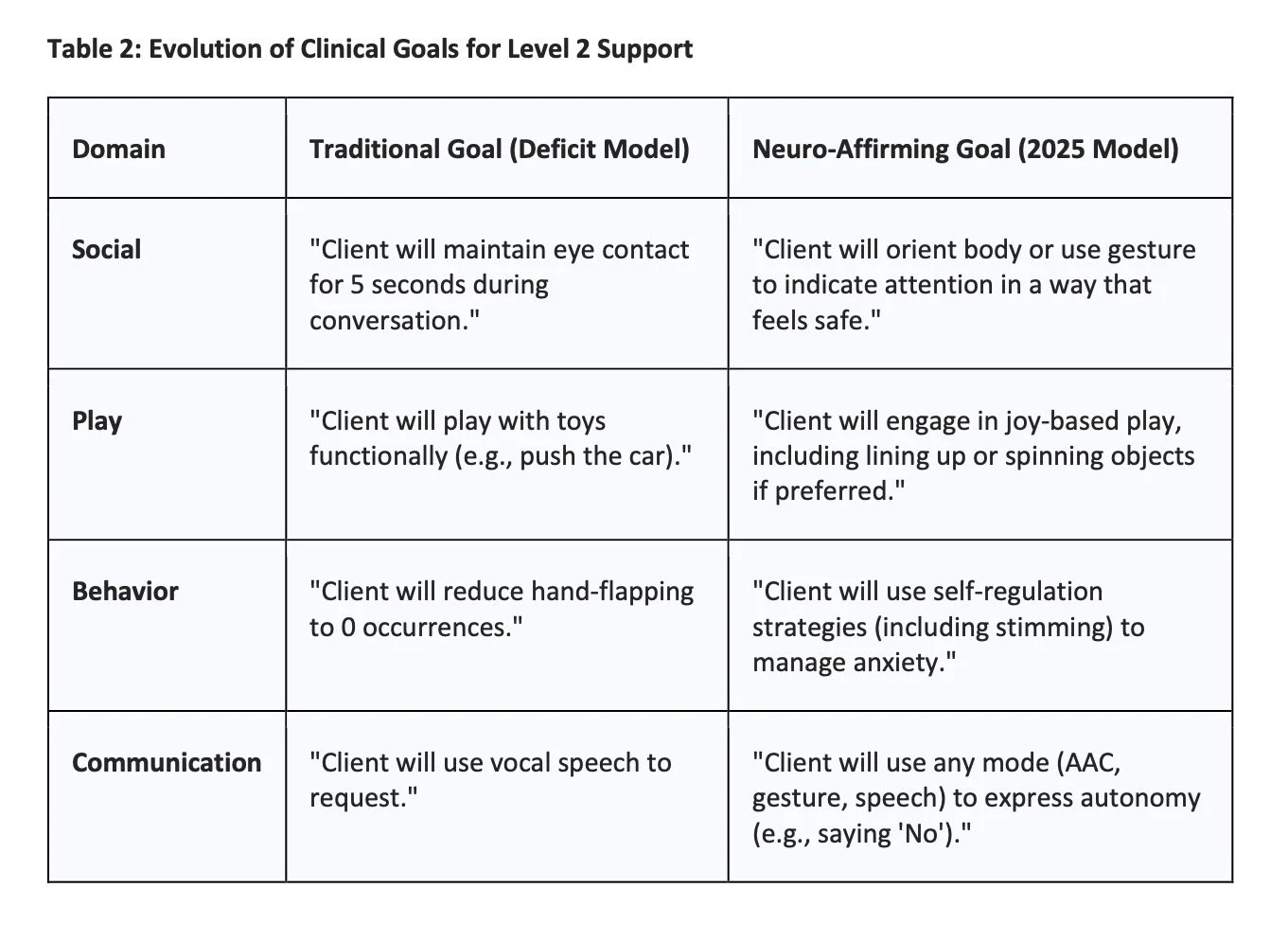
This shift is documented in updated frameworks for speech-language pathology and occupational therapy, which explicitly warn against goals that induce masking.17
4. Applied Therapeutics for Substantial Support Needs (Level 2)
Individuals with Level 2 autism require "substantial support." The 2020-2025 research literature highlights that effective intervention for this group must be intensive yet naturalistic, robustly supported by technology, and centered on physiological regulation rather than behavioral suppression.
4.1 Naturalistic Developmental Behavioral Interventions (NDBI)
NDBIs represent the evolution of behavioral science, merging the principles of Applied Behavior Analysis (ABA) with developmental science. Unlike Discrete Trial Training (DTT), which occurs in a structured, often artificial setting, NDBIs (such as JASPER, Early Start Denver Model, and Project ImPACT) are implemented in natural environments like play and daily routines.
4.1.1 Efficacy in Group and Telehealth Settings
Recent studies (2024-2025) have validated the scalability of NDBIs, which is crucial given the shortage of providers.
Group-Based NDBI: A study published in Journal of Speech, Language, and Hearing Research (2025) examined group-based NDBI for young autistic children. It demonstrated significant increases in "active engagement" and social relatedness over a 10-month period.28 The study highlighted that while the group average improved, individual trajectories varied based on baseline social pragmatic skills, suggesting that Level 2 children may need "priming" or 1:1 breakout sessions to fully benefit from group work.
Telehealth Efficacy: A mixed-methods pilot study of Project ImPACT delivered via telehealth showed statistically significant decreases in peer interaction challenges.30 This confirms that parents can be effectively coached to deliver high-fidelity NDBI strategies at home, a vital finding for addressing health equity in underserved regions.
4.2 The Low Arousal Approach
For individuals with Level 2 support needs, who may experience frequent dysregulation or "meltdowns" due to the thalamic gating issues described earlier, the Low Arousal Approach has emerged as a gold standard in crisis management.31
4.2.1 Mechanism and Application
The approach is predicated on the understanding that challenging behavior is often a panic response (Fight/Flight) fueled by sensory and emotional overload.
Reducing Demands: In a moment of escalation, the immediate goal is safety, not compliance. The Low Arousal protocol dictates dropping all demands to lower the cognitive load.
Sensory Reduction: Interventions involve lowering lights, reducing verbal input (stopping the "talking at" the person), and increasing physical space to reduce the perception of threat.
Affect Regulation: The caregiver must manage their own emotional state ("Peace of mind is contagious") to prevent emotional contagion, where the caregiver's stress further escalates the autistic individual.32
Unlike restraint or seclusion, which increase physiological arousal and trauma, this approach aims to lower the "temperature" of the interaction. It shifts the focus from "consequences" to "antecedent management"—changing the environment before the crisis occurs.
4.3 Augmentative and Alternative Communication (AAC)
For Level 2 individuals, communication barriers are a primary source of frustration and behavior. The 2025 landscape for AAC emphasizes "Robust AAC" systems and the presumption of competence.
4.3.1 Moving Beyond "Requesting"
Historically, AAC for substantial support needs often focused on "wants and needs" (e.g., asking for a cookie). Current best practices 34 emphasize a Core Vocabulary approach—teaching high-frequency words (go, stop, more, help, different) that allow for a wide range of communicative functions, including commenting, protesting, and asking questions.
4.3.2 Techno-Ableism and Multi-Modal Communication
A critical 2025 discourse involves "techno-ableism"—the assumption that high-tech devices are superior or curative. Research cautions that while speech-generating devices are powerful, they must not replace multi-modal communication.36 Gestures, leading an adult by the hand, vocalizations, and low-tech picture boards are all valid forms of language. The goal is autonomous communication, not just the use of a device.
4.4 Interoception-Based Interventions
Given the insular hypoconnectivity and alexithymia common in Level 2 autism, teaching interoception has become a therapeutic priority. The work of Kelly Mahler and others has been adapted specifically for non-speaking clients.37
4.4.1 The Curriculum for Non-Speakers
Standard interoception curricula often rely on verbal dialogue ("How does your stomach feel?"). Adaptations for 2025 involve:
Modeling: The therapist narrates their own bodily sensations ("I am yawning; my energy feels low").
Tactile Exploration: Using "Body Experiments" (e.g., holding an ice cube vs. a warm towel) to help the individual connect sensation to vocabulary without requiring verbal output.39
Co-Regulation: Using the therapist's regulated state to help the client feel safe enough to notice internal signals.40
4.5 Peer-Mediated Instruction and Intervention (PMI)
PMI involves training neurotypical peers to support autistic students. While highly effective for social inclusion, 2025 reviews note a gap in research for students with substantial support needs.41 However, when adapted—for instance, training peers to use the autistic student's AAC device or to engage in the autistic student's preferred "special interest" play—PMI promotes genuine inclusion and breaks down social isolation.42
5. Daily Life Assistance, Executive Function, and Technology
For individuals with Level 2 autism, the "executive function" gap—planning, organizing, initiating tasks, and working memory—is often a greater barrier to independence than social deficits. The 2020-2025 period has seen a surge in "Assistive Tech" that acts as a prosthetic for executive function.
5.1 AI-Driven Executive Function Support
Artificial Intelligence has moved from novelty to utility in autism support. By 2025, apps like Tiimo and Thruday utilize AI to create dynamic, visual schedules that adapt to the user's needs.44
Predictive Scheduling: Newer algorithms can analyze behavioral data (if integrated with wearables) to predict "triggers." If a user typically becomes dysregulated after 20 minutes of a specific task, the AI can suggest a break before the meltdown occurs.46
Visualizing Time: Time blindness is a common feature of autism. Apps that use visual timers (e.g., a disappearing red disk) provide concrete representations of abstract concepts, reducing anxiety during transitions.47
5.2 Video Modeling for Daily Living Skills (DLS)
Acquiring daily living skills (hygiene, cooking, cleaning) is a primary goal for Level 2 support. Video Modeling has proven exceptionally effective for this population.
Mechanism: It bypasses the social-processing demand of face-to-face instruction. The individual watches a video of the task (from a first-person perspective) and imitates it. This aligns with the "visual learning" strength of many autistic people.
2025 Efficacy Data: Case studies and meta-analyses confirm that video modeling is effective for complex chains of behaviors (e.g., washing dishes, doing laundry) and that skills are maintained over time without the need for constant supervision.49
Implementation: Using tablets to display the video step-by-step at the point of performance (e.g., an iPad mounted in the bathroom playing a "brushing teeth" clip) allows for real-time prompting.
5.3 Safety Skills and Elopement
Elopement (wandering) remains a critical safety concern for Level 2 families. Interventions in 2025 focus on Behavioral Skills Training (BST) and environmental modification.
Water Safety: Given the high risk of drowning, specialized swim instruction that includes clothes-on swimming and safety commands is essential. Programs now focus on "survival swimming" rather than stroke technique.52
Tech Solutions: Passive measures like GPS trackers and door alarms are standard, but active safety involves teaching "stop" commands using high-reinforcement protocols (e.g., practicing stopping at a curb for a high-value reward).53
5.4 Transition Support Strategies
Transitions are a flashpoint for dysregulation due to Monotropism (the intense, single-track focus of the autistic mind). Evidence-based strategies for substantial support needs include:
Priming: Warning the individual about what is coming next well in advance to allow for cognitive shifting.
Visual Countdowns: Using a visual countdown (5-4-3-2-1 cards) rather than just a verbal one, which may be missed if auditory processing is overwhelmed.
Transitional Objects: Allowing a preferred item (e.g., a toy car) to travel from activity A to activity B to maintain a sense of continuity and safety.47
6. The Lifespan Perspective: Adulthood and Systemic Support
The "Services Cliff"—the drastic reduction in support after high school—remains a critical issue in 2025. With 1 in 31 children now diagnosed, the wave of autistic adults entering the system is unprecedented.1
6.1 The State of Adult Services
Employment: While 8 out of 10 eligible autistic adults enroll in job training, only half secure employment. This discrepancy highlights a systemic failure in "transition" planning and workplace accommodation. The focus is often on training the individual, rather than modifying the workplace to be sensory-friendly.57
Housing: 1 in 4 families with an autistic child faces housing insecurity, exacerbated by the lack of specialized, affordable adult housing options that provide Level 2 support (e.g., semi-independent living with drop-in support).57
Day Programs: For Level 2 adults, day programs are shifting from "custodial care" to "community integration." Programs like Avondale House and university-based initiatives (e.g., IMPACT at the University of Cincinnati) focus on vocational skills, communication, and recreation rather than mere supervision.58
6.2 Social Isolation and Mental Health
Loneliness is a significant health risk for autistic adults, comparable to smoking in its physical effects. Research in 2025 clarifies that autistic adults desire connection but often lack the "neuro-affirming" spaces to find it.60
Affinity Groups: Groups based on shared interests (Special Interests) are more successful than general "social skills" groups. When autistic adults gather around a shared passion (e.g., anime, coding, trains), social barriers often dissolve.
Adult Support Groups: Organizations like AANE and The Autism Project offer online and in-person groups that validate autistic identity rather than trying to "cure" it. These "closed" groups allow adults to discuss burnout, sensory issues, and navigation of the neurotypical world with peers who understand.62
7. Pharmacological, Genetic, and Medical Updates (2025)
While behavioral and educational interventions are primary, 2025 has seen notable medical updates relevant to Level 2 support, particularly concerning co-occurring metabolic and genetic conditions.
7.1 Leucovorin and Cerebral Folate Deficiency (CFD)
In September 2025, the FDA initiated approval for Leucovorin calcium for patients with Cerebral Folate Deficiency (CFD).64
Mechanism: CFD is a condition where folate (vitamin B9) cannot cross the blood-brain barrier due to the presence of autoantibodies. This deficiency leads to developmental delays, seizures, and autistic symptoms. Leucovorin is a reduced folate that bypasses this blocked transport mechanism.
Relevance: CFD is highly comorbid with autism (and often undiagnosed). Treating the folate deficiency can lead to significant improvements in speech and social interaction for the subset of autistic individuals with this metabolic profile.
7.2 Prenatal Acetaminophen (Tylenol) Warnings
The FDA has issued updated warnings regarding the use of acetaminophen during pregnancy, citing a "considerable body of evidence" suggesting a correlation (though not definitively causal) with increased risks of autism and ADHD.66 This remains a contentious area, but the shift in guidance represents a precautionary approach in prenatal care.
7.3 Genetic Architecture and Personalized Medicine
Research has identified 230 new genes linked to ASD as of 2024.9 The Autism Data Science Initiative (ADSI) is currently using machine learning to parse how these genes interact with environmental factors.1 This supports the move toward "personalized medicine," where interventions might eventually be tailored to an individual's specific genetic and neural profile (e.g., treating those with the Cntnap2 variance with RT-targeting therapies, while others might benefit more from oxytocin-pathway interventions).
8. Conclusion: A New Era of Informed Support
The research of 2020-2025 has coalesced into a clear, evidence-based narrative for Level 2 support: Intervention must be biologically informed but humanistically delivered.
We have moved beyond the "black box" era. We now understand the biological reality of sensory overwhelm (the Reticular Thalamic Nucleus), the structural reality of hyper-connectivity (Synaptic Density), and the social reality of the Double Empathy Problem.
8.1 Key Takeaways for Support Providers
Respect the Neurology: Use Low Arousal strategies not just because they are "nice," but because the Level 2 brain is physiologically wired for intensity and lacks the gating mechanisms to filter noise.
Prioritize Interoception: Teach the individual to feel their body (heart rate, tension) before expecting them to regulate their behavior. Emotional regulation is impossible without interoceptive awareness.
Leverage Technology: Use AI scheduling and video modeling to bypass executive function deficits, acting as a digital prosthetic for the frontal lobe.
Affirm Identity: Ensure that social support validates the autistic experience. Stop fighting the symptoms (stimming, monotropism) and start supporting the person (autonomy, safety, connection).
By aligning support strategies with the biological reality of the autistic brain—respecting its intense connectivity and unique sensory gating—we can build lives of quality, connection, and dignity for individuals with substantial support needs. The future of autism support is not about "fixing" the individual, but about optimizing the environment and the understanding of those around them.
Works cited
Autism Announcement Fact Sheet | HHS.gov, accessed December 13, 2025, https://www.hhs.gov/press-room/autism-announcement-fact-sheet.html
CDC Community Report on Autism 2025, accessed December 13, 2025, https://www.cdc.gov/autism/media/pdfs/2025/04/ADDM-Community-Report-SY2022.pdf
High-Level Support in Autism - Apex ABA Therapy, accessed December 13, 2025, https://www.apexaba.com/blog/high-level-support-in-autism
Repurposed epilepsy drugs show potential for new autism therapies - Drug Target Review, accessed December 13, 2025, https://www.drugtargetreview.com/news/184268/repurposed-epilepsy-drugs-show-potential-for-new-autism-therapies/
A Key Brain Difference Linked to Autism Is Found for the First Time in Living People, accessed December 13, 2025, https://medicine.yale.edu/news-article/a-key-brain-difference-linked-to-autism-is-found-for-the-first-time-in-living-people/
Affirming Neurodiversity within Applied Behavior Analysis - PMC - PubMed Central - NIH, accessed December 13, 2025, https://pmc.ncbi.nlm.nih.gov/articles/PMC11219658/
Facts About Autism: Comprehensive Overview for 2025 - Abacus Therapies, accessed December 13, 2025, https://abacustherapies.com/facts-about-autism-comprehensive-overview-for-2024/
Science Updates About Autism Spectrum Disorder (ASD), accessed December 13, 2025, https://www.nimh.nih.gov/news/science-updates/autism-spectrum-disorder-asd
Promising Autism Research Breakthroughs in 2025: New Hope for Understanding and Treatment, accessed December 13, 2025, https://linksaba.com/promising-autism-research-breakthroughs/
Stanford study shows autism-like behaviors can be switched off in mice - PsyPost, accessed December 13, 2025, https://www.psypost.org/stanford-study-shows-autism-like-behaviors-can-be-switched-off-in-mice/
Hyperactivity in reticular thalamic nucleus drives autism-like behaviors in mice, accessed December 13, 2025, https://www.news-medical.net/news/20250820/Hyperactivity-in-reticular-thalamic-nucleus-drives-autism-like-behaviors-in-mice.aspx
Reticular Thalamic Hyperexcitability Drives Autism Spectrum Disorder Behaviors in the Cntnap2 Model of Autism | bioRxiv, accessed December 13, 2025, https://www.biorxiv.org/content/10.1101/2025.03.21.644680v1.full-text
Reticular thalamic hyperexcitability drives autism spectrum disorder behaviors in the Cntnap2 model of autism - PMC - PubMed Central, accessed December 13, 2025, https://pmc.ncbi.nlm.nih.gov/articles/PMC12366697/
Thalamic functional connectivity and sensorimotor processing in neurodevelopmental disorders - PMC - PubMed Central, accessed December 13, 2025, https://pmc.ncbi.nlm.nih.gov/articles/PMC10755010/
Children with Autism Have Extra Synapses in Brain, accessed December 13, 2025, https://www.cuimc.columbia.edu/news/children-autism-have-extra-synapses-brain
Autistic Brain vs Normal Brain: Decoding Neurodiversity - Yellow Bus ABA, accessed December 13, 2025, https://www.yellowbusaba.com/post/autistic-brain-vs-normal-brain
Neurodiversity-Affirming Therapy: Positions, Therapy Goals, and Best Practices, accessed December 13, 2025, https://therapistndc.org/neurodiversity-affirming-therapy/
Neural Mechanisms of Emotion Regulation in Autism Spectrum Disorder - PubMed Central, accessed December 13, 2025, https://pmc.ncbi.nlm.nih.gov/articles/PMC4515208/
Neural Mechanisms of Emotion Regulation in Autism Spectrum Disorder, accessed December 13, 2025, https://cdr.lib.unc.edu/concern/articles/cf95jk09n
Mapping brain functional and structural abnormities in autism spectrum disorder: moving toward precision treatment - Oxford Academic, accessed December 13, 2025, https://academic.oup.com/psyrad/article/2/3/78/6815557
Ask a Lurie Center Researcher: Autism and Interoception: Understanding the Body's Hidden Signals, accessed December 13, 2025, https://www.massgeneral.org/assets/mgh/pdf/children/lurie-center-lurienow-autism-and-interoception.pdf
Occupational Therapy Practice Guidelines for Autistic People Across the Lifespan, accessed December 13, 2025, https://research.aota.org/ajot/article/78/3/7803397010/25188/Occupational-Therapy-Practice-Guidelines-for
Moving Toward Neurodiversity-Affirming Occupational Therapy for Autistic People: Key Questions and Next Steps - WMU's ScholarWorks, accessed December 13, 2025, https://scholarworks.wmich.edu/cgi/viewcontent.cgi?article=2244&context=ojot
2025 Neurodiversity Affirming Practice Speakers - STAR Institute, accessed December 13, 2025, https://sensoryhealth.org/basic/2025-neurodiversity-affirming-practice-speakers
Neurodiversity Affirming Therapy Practices: Complete Guide - ABA & Autism Therapy Services, accessed December 13, 2025, https://kctherapy.com/neurodiversity-affirming-therapy-practices/
Autism and communication - National Autistic Society, accessed December 13, 2025, https://www.autism.org.uk/advice-and-guidance/topics/about-autism/autism-and-communication
Neurodivergent-Affirming SLT | AutisticSLT, accessed December 13, 2025, https://www.autisticslt.com/nd-affirmingslt
Effects of an Inclusive Group-Based Naturalistic Developmental Behavioral Intervention on Active Engagement in Young Autistic Children: A Preliminary Study - PubMed, accessed December 13, 2025, https://pubmed.ncbi.nlm.nih.gov/39879478/
Effects of an Inclusive Group-Based Naturalistic Developmental Behavioral Intervention on Active Engagement in Young Autistic Children: A Preliminary Study - Johns Hopkins University, accessed December 13, 2025, https://pure.johnshopkins.edu/en/publications/effects-of-an-inclusive-group-based-naturalistic-developmental-be/
Telehealth Pilot Study of the Effects of a Naturalistic Developmental Behavioral Intervention on Child Social Communication Outcomes in a Community Mental Health System - MDPI, accessed December 13, 2025, https://www.mdpi.com/2076-328X/15/9/1171
The Low Arousal Approach: A Practitioner's Guide - BCU Open Access Repository - Birmingham City University, accessed December 13, 2025, https://www.open-access.bcu.ac.uk/6544/1/the-low-arousal-approach.pdf
Low Arousal and Effective Crisis Management in a World of Noise - Studio 3, accessed December 13, 2025, https://www.studio3.org/post/low-arousal-and-effective-crisis-management-in-a-world-of-noise
What is the Low Arousal Approach and How Can It Benefit My Family?, accessed December 13, 2025, https://autismawarenesscentre.com/what-is-the-low-arousal-approach-and-how-can-it-benefit-my-family/
AAC in Autism, accessed December 13, 2025, https://www.advancedautism.com/post/aac-in-autism
Communication in Autistic Adults: An Action-Focused Review - PMC - PubMed Central, accessed December 13, 2025, https://pmc.ncbi.nlm.nih.gov/articles/PMC12271282/
Full article: Dismantling societal barriers that limit people who need or use AAC: lived experiences, key research findings, and future directions - Taylor & Francis Online, accessed December 13, 2025, https://www.tandfonline.com/doi/full/10.1080/07434618.2025.2508490
On-Demand Course: Interoception and the Non-Speaking Client - Kelly Mahler, accessed December 13, 2025, https://www.kelly-mahler.com/product/on-demand-course-interoception-and-the-non-speaking-client/
Interoception and Non-Speaking/Verbal Autistic Clients | Kelly Mahler, accessed December 13, 2025, https://www.kelly-mahler.com/interoception-non-speaking-autistic/
Interoception: Body Awareness Exercises - Autism Connection of Pennsylvania, accessed December 13, 2025, https://autismofpa.org/interoception-body-awareness-exercises-for-autistic-children/
Interoception and the Non-Speaking Client | Kelly Mahler Blog, accessed December 13, 2025, https://www.kelly-mahler.com/resources/blog/interoception-and-the-non-speaking-client/
A systematic review of peer-mediated interventions for children with autism spectrum disorder - NIH, accessed December 13, 2025, https://pmc.ncbi.nlm.nih.gov/articles/PMC5087797/
Peer-Mediated Instruction in Autism, accessed December 13, 2025, https://www.advancedautism.com/post/peer-mediated-instruction-in-autism
Peer-Mediated Instruction And Intervention In Autism, accessed December 13, 2025, https://www.ambitionsaba.com/resources/peer-mediated-instruction-and-intervention-in-autism
Neuroinclusive AI Planning | Smarter, Adaptive Support for ADHD & Autism - Tiimo App, accessed December 13, 2025, https://www.tiimoapp.com/resource-hub/ai-planner
Thruday | Visual Planner & To-Do App for ADHD & Autism, accessed December 13, 2025, https://thruday.com/
Latest Advancements in Autism Therapy: 2025 Trends to Watch - AB Spectrum, accessed December 13, 2025, https://www.abspectrum.org/advancements-in-autism-therapy-2025/
Transition Time: Helping Individuals on the Autism Spectrum Move Successfully from One Activity to Another, accessed December 13, 2025, https://iidc.indiana.edu/irca/articles/transition-time-helping-individuals-on-the-autism-spectrum-move-successfully-from-one-activity-to-another.html
Using Technology to Support Executive Functioning Skills in Adults with Autism, accessed December 13, 2025, https://gershautismacademy.com/blog/using-technology-to-support-executive-functioning-skills-in-adults-with-autism/
EJ1373145 - Video Modeling and Daily Living Skills Training in Students with ASD, Journal of Educational Sciences, 2022 - ERIC, accessed December 13, 2025, https://eric.ed.gov/?id=EJ1373145
Examining the Effects of Video Modeling and Prompts to Teach Activities of Daily Living Skills - NIH, accessed December 13, 2025, https://pmc.ncbi.nlm.nih.gov/articles/PMC5118254/
Teaching Daily Living Skills to Children with Autism Through Instructional Video Modeling, accessed December 13, 2025, https://www.researchgate.net/publication/247784937_Teaching_Daily_Living_Skills_to_Children_with_Autism_Through_Instructional_Video_Modeling
ABA strategies for teaching safety skills - Ambitions ABA Therapy, accessed December 13, 2025, https://www.ambitionsaba.com/resources/aba-strategies-for-teaching-safety-skills
Strategies For Enhancing Safety For Autistic Children - Autism Learning Partners, accessed December 13, 2025, https://autismlearningpartners.com/nurturing-safety/
Teaching Safety Skills to Children: A Discussion of Critical Features and Practice Recommendations - PMC - NIH, accessed December 13, 2025, https://pmc.ncbi.nlm.nih.gov/articles/PMC9582057/
Children, Autism, and Change: Tips to Make Transition Easier | Brown University Health, accessed December 13, 2025, https://www.brownhealth.org/be-well/children-autism-and-change-tips-make-transition-easier
Improving Transition to Adulthood for Students with Autism: A Randomized Controlled Trial of STEPS - PubMed Central, accessed December 13, 2025, https://pmc.ncbi.nlm.nih.gov/articles/PMC8513749/
2025 Autism by the Numbers Annual Report now live, accessed December 13, 2025, https://www.autismspeaks.org/science-news/2025-autism-numbers-annual-report-now-live
Adult Day Program - Avondale House, accessed December 13, 2025, https://www.avondalehouse.org/services-adult-day-program
ADULT DAY ARRAY GUIDE 2025 - Hamilton County Developmental Disabilities Services, accessed December 13, 2025, https://www.hamiltonddsohio.gov/wp-content/uploads/2025/04/2025-ADA-Provider-Guide-2.pdf
Friendship, Loneliness and Belonging in Autistic People - Reframing Autism, accessed December 13, 2025, https://reframingautism.org.au/friendship-loneliness-and-belonging-in-autistic-people/
Experiences of friendship among autistic adults: a scoping review - PMC - PubMed Central, accessed December 13, 2025, https://pmc.ncbi.nlm.nih.gov/articles/PMC12034726/
Autistic Adult - AANE, accessed December 13, 2025, https://aane.org/autistic-adult/
Finding your community | Autism Speaks, accessed December 13, 2025, https://www.autismspeaks.org/finding-your-community
FDA Takes Action to Make a Treatment Available for Autism Symptoms, accessed December 13, 2025, https://www.fda.gov/news-events/press-announcements/fda-takes-action-make-treatment-available-autism-symptoms
President Trump, Secretary Kennedy Announce Bold Actions to Tackle Autism Epidemic, accessed December 13, 2025, https://www.hhs.gov/press-room/hhs-trump-kennedy-autism-initiatives-leucovorin-tylenol-research-2025.html
FDA Responds to Evidence of Possible Association Between Autism and Acetaminophen Use During Pregnancy, accessed December 13, 2025, https://www.fda.gov/news-events/press-announcements/fda-responds-evidence-possible-association-between-autism-and-acetaminophen-use-during-pregnancy
Mount Sinai Study Supports Evidence That Prenatal Acetaminophen Use May Be Linked to Increased Risk of Autism and ADHD, accessed December 13, 2025, https://www.mountsinai.org/about/newsroom/2025/mount-sinai-study-supports-evidence-that-prenatal-acetaminophen-use-may-be-linked-to-increased-risk-of-autism-and-adhd
Disclaimer
The content provided in this article is for general informational purposes only and does not constitute legal, clinical, or specialist behaviour support advice. It should not be relied upon as such.
All information is provided in good faith, however, we make no representation or warranty of any kind, express or implied, regarding the accuracy, adequacy, validity, reliability, or completeness of any information. The information pertaining to Autism and support methods must be individually determined by each person’s GP and specialist therapists, and is a very complex evolving context and support needs and methods are subject to change.
This article is not a substitute for professional advice from a qualified NDIS Behaviour Support Practitioner. You should always consult with an appropriate professional to address your specific circumstances. Under no circumstance shall Ability Therapy Specialists Pty Ltd have any liability to you for any loss or damage incurred as a result of the use of this information. Reliance on any information provided in this post is solely at your own risk. This article, website, and your participation are governed under the Client Booklet - Privacy Policy: Disclaimer, Terms, Conditions as a necessary provision under Australian service quality standards.