Turning the tide: A practical, in-depth view for getting the best behaviour support plan.
Dr Jo Bowers PhD
I hear this exhaustion in practice every single week. By the time a family reaches specialist behaviour support, you have spent years advocating for your adult child. We write this paper with parents of adult children in mind, because they are often overlooked by the system—even though they represent every parent in a way, as our children grow over many years. Parents never cease being parents, especially with a child with special needs and distinct vulnerabilities.
That said, this paper can be read by parents of young or underage children; the meaning is much the same. We are talking about ways toward getting quality outcomes for our child.
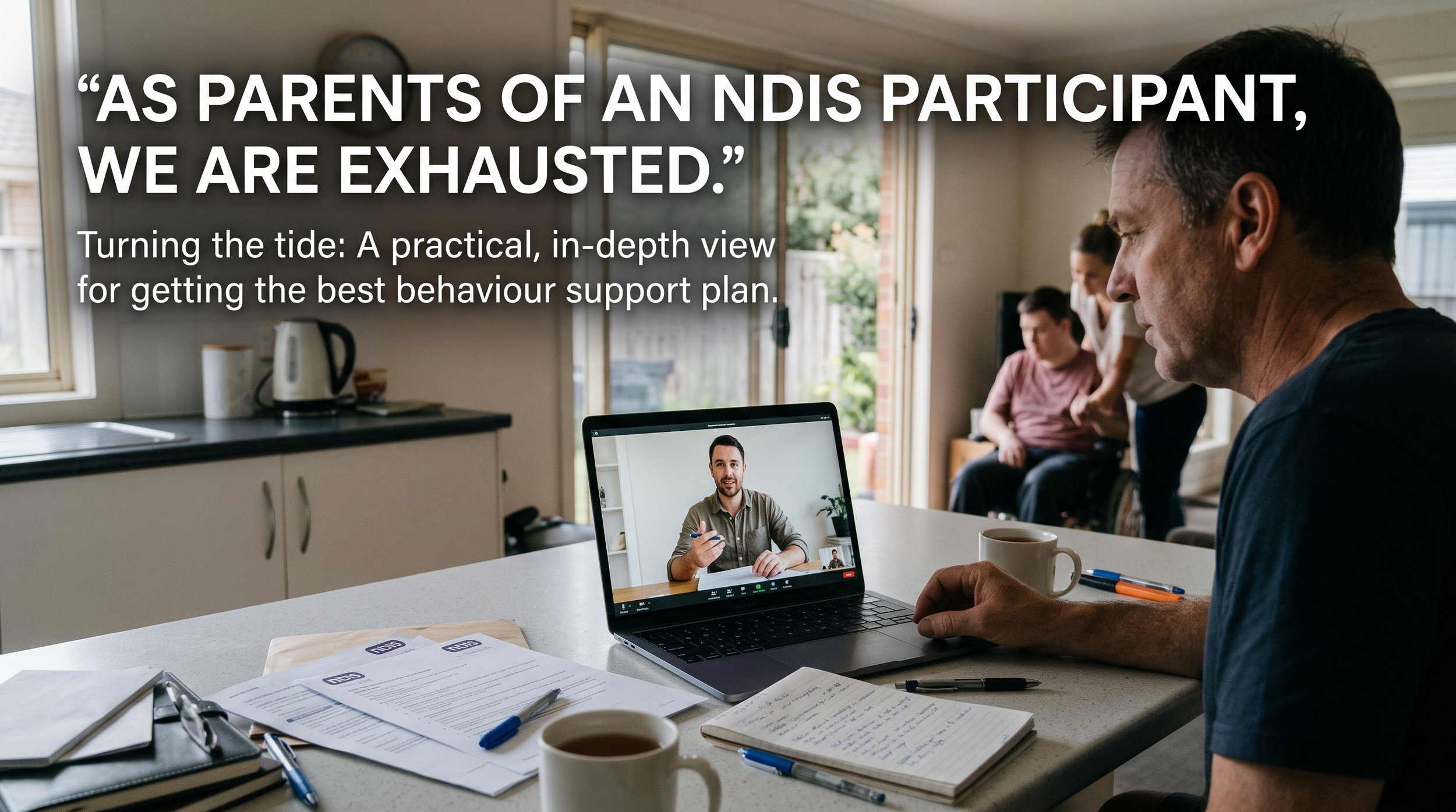
NDIS Participant’s Dad online with Behaviour Support Therapist in the Kitchen at Home with Son in Background
Funding & Politics vs. Everyday Real Life
You already know the unwritten rule of the system: securing NDIS funding requires a heavy focus on clinical language, functional incapacity, and deficit-based justification. You also know that this clinical language rarely helps you on a Tuesday morning when a crisis is unfolding in your kitchen.
When a Behaviour Support Plan (BSP) fails to improve a participant's quality of life, the default reaction for many parents is guilt. You might wonder if you are implementing it wrong. But the reality is often structural: the demands of NDIS compliance can easily override the need for practical, real-life solutions, resulting in a document that satisfies the regulators but is completely unworkable for your family.
As a practitioner who advocates for person-centred best practice, I want to lift that burden off your shoulders. Turning the tide means recognizing that best practice does not force you to choose between a compliant plan and a practical one. You have the right to expect both.
The Validation in the Data
If you feel let down by the system, the data proves you are not imagining it. The NDIS Quality and Safeguards Commission’s Behaviour Support Plan Quality Snapshot 2026 paints a stark picture of the sector.
When the Commission reviewed recent plans across the country, 42% were graded as 'weak' and 32% as 'underdeveloped'. Only 6% reached the benchmark of 'superior'. The national average score for a plan sits at just 14.1 out of a possible 34 points—barely scraping past the absolute minimum score of 13 required to be considered acceptable.
What does this mean for you? It means that nearly three-quarters of the plans handed to families and support workers are not equipped to create lasting, positive change. They are built for compliance, not for real life.
Recognizing the "Paperweight Plan"
To demand better, we first need to identify what an underdeveloped plan looks like in practice. If your adult child's current plan has any of these red flags, it is a sign that the document is failing them:
The "Copy-Paste" Feel: If you covered up your child's name, could this plan be about anyone? An underdeveloped plan reads like a generic textbook. It lists standard strategies—like "take deep breaths" or "use a sensory room"—without addressing the unique personality, history, and preferences of your adult child.
All Management, No Teaching: Poor plans focus entirely on what support workers should do after a crisis starts. They are heavily weighted toward managing risk and compliance, rather than teaching your child a new, effective way to communicate their needs or cope with their environment.
The Invisible Adult: As our children become adults, their right to autonomy, dignity, and risk takes center stage. A weak plan treats the adult participant as a problem to be managed, rather than a person to be consulted. If the plan’s primary goal is to make your child "compliant" rather than happy, independent, and engaged in their community, it has missed the mark.
The Dual Track: Compliance and Practical Coaching
The most effective behaviour support operates on two tracks simultaneously. It fulfills the strict, external demands of the NDIS while providing active, real-time coaching for your family.
A best-practice practitioner will work closely with you to create a plan that meets all compliance measures, while simultaneously clearing the pathway forward with direct, practical conversations. You shouldn't just be handed a manual; you should be actively learning new skills alongside the practitioner to support your adult child safely.
These practical, day-to-day strategies are often worked out together in real-time, well before the final paperwork is submitted. To understand how this works, it helps to understand the timeline of how these documents are actually built:
Month 1: The Functional Behaviour Assessment (FBA). This is the clinical foundation. The FBA gathers data and establishes the formal justification required for funding. It explores the "why" behind the behaviours of concern, focusing heavily on clinical analysis.
Day 30: The Interim Behaviour Support Plan. Required within 30 days of your service agreement date, this is a rapid-response document focused on immediate safety, risk reduction, and initial support strategies.
Month 6: The Comprehensive Behaviour Support Plan. This is where the practical support methods live. It is the finalized document that combines the clinical findings of the FBA with the real-world interventions you and the practitioner have spent the last few months testing and refining.
Co-Writing: The End of the "Paperweight Plan"
The wider sector data shows a concerning trend: many families receive a finalized BSP and read it as if they had no part in its creation. Best practice flips this dynamic entirely. A comprehensive BSP should be a co-authored document. It should capture the practical solutions you have already discussed and tested together.
During the drafting process, you should be actively invited to comment, question, and disagree with the strategies presented. The most valuable sentence a parent can say during this process is: "We can't do that—what else could we do?"
If a suggested intervention looks great in clinical theory but is impossible for you or your support workers to implement, the document must change. The final draft is only written up after these practical realities have been ironed out in collaboration with you.
The Anatomy of a Practical, Best-Practice BSP
When you are reviewing a draft with a practitioner, it helps to know exactly what structure to look for. A practical, high-quality BSP is generally broken down into highly actionable sections:
About the Person (Data-Driven Empathy): This section must look beyond the disability. It captures who the person is, their strengths, their history, and their goals for a self-directed adult life. If you cannot recognize your child in this section, the plan is too generic.
Behaviours of Concern: A clear, objective breakdown of the behaviours, their triggers, and the function they serve (e.g., communication, sensory regulation, seeking autonomy). We don't just guess; we figure out exactly what your adult child is trying to tell us.
Prevention, Intervention, and Real-World Skill Building: This is the core of the document. It details how to adjust the environment to proactively reduce risks, and provides step-by-step guidance on how to safely support the person if a behaviour occurs. Crucially, it must actively teach a better way to get that same need met—whether that is learning to use an alternative communication device, managing a budget to increase independence, or developing specific self-advocacy skills.
Restrictive Practices (If Necessary): If regulated restrictive practices are required for safety, this section outlines the strict protocols for their use, alongside a mandatory, clear pathway for how those practices will be safely reduced or faded out over time.
Your Practical Toolkit: Questions to Ask
You do not need a clinical degree to demand best practice. The next time you sit down with a practitioner to draft or review a behaviour support plan, bring this list of questions to the table:
"Could I recognize my child from reading the first two pages of this plan?" (Ensure it captures their strengths, hobbies, and personality, not just their deficits).
"What specific new skill is this plan actively teaching them, and how are we measuring it?" (Shift the focus from stopping behaviors to building independence).
"Can you explain the 'why' behind this behaviour in plain English?" (Ensure the practitioner truly understands the function of the behaviour).
"Are the strategies in this plan actually realistic for my family and the support workers to do on a Tuesday morning?" (If it doesn't work in real life, it doesn't work).
"How does this plan directly support my child's personal goals for their adulthood?" (Anchor the clinical work to their right to a fulfilling, self-directed life).
You have every right to be exhausted by the system. But by understanding how clinical compliance and practical coaching should seamlessly integrate, you have the power to turn the tide. By knowing what standard to expect, you can partner with practitioners who will look beyond the paperwork and see the adult you have fought so hard for all these years.
References
NDIS Quality and Safeguards Commission. (2026). Behaviour Support Plan Quality Snapshot. Australian Government. (Note: This is the primary source for the 2026 data points regarding plan quality scores, the 14.1 national average, and the percentages of plans graded as 'weak', 'underdeveloped', and 'superior'.)
NDIS Quality and Safeguards Commission. (2026). Positive Behaviour Support Capability Framework. Australian Government. (Note: This framework underpins the core arguments in the paper regarding practitioner best practice, genuine consultation, and person-centred skill building.)
Australian Government. (2018, incorporating 2026 legislative reforms). National Disability Insurance Scheme (Restrictive Practices and Behaviour Support) Rules. Federal Register of Legislation. (Note: This is the legislative source for the statutory timeline cited in the paper: the requirement for an Interim Behaviour Support Plan within 30 days, and a Comprehensive Behaviour Support Plan within 6 months.)
NDIS Quality and Safeguards Commission. (2026). Compendium of Resources for Positive Behaviour Support: Restrictive Practice Fade-Out. Australian Government. (Note: This supports the data and best-practice standards regarding the mandatory inclusion of fade-out strategies and environmental modifications.)
Resources Links (References Used)
To be practical and a bit more helpful, here are the direct links to the foundational, real-world NDIS Commission resources that underpin these citations. Note these links were tested when we created this paper but they may go out of date over time so we suggest taking the words and doing your own search. Or visit the NDIS Commission website directly for more up to date information.
1. Behaviour Support Plan Quality Evaluation (The "Quality Snapshot" Data)
The NDIS Quality and Safeguards Commission conducts systematic evaluations of Behaviour Support Plans using the BSP-QEII tool to generate quality snapshots and public papers.
2. Positive Behaviour Support Capability Framework
This is the core framework that dictates practitioner best practice, genuine consultation, and person-centred approaches.
3. National Disability Insurance Scheme (Restrictive Practices and Behaviour Support) Rules
This is the Federal legislative document that outlines the strict statutory timelines (like the 30-day requirement for Interim Plans and 6 months for Comprehensive Plans) and compliance mandates.
Link: NDIS (Restrictive Practices and Behaviour Support) Rules 2018 (Federal Register of Legislation)
4. Compendium of Resources for Positive Behaviour Support
This Commission guide details best-practice strategies for assessments and the mandatory requirements for restrictive practice "fade-out" planning.
Link: Compendium of Resources for Positive Behaviour Support (PDF)
Link: Behaviour Support Assessment & Functional Behaviour Assessment: Practice Guide (PDF)
About the author
Dr Joseph R Bowers is a PhD in Counselling Psychotherapy and a Senior Specialist Behaviour Support Practitioner who is registered with the NDIS Commission. He has worked full time in behaviour support services since 2011, then under ADHC NSW and with the transition into NDIS Dr Bowers founded Ability Therapy Specialists Pty Ltd to continue offering tailored person centred and international standards of best practice to rural, regional and remote Australians. As a telehealth service, ATS reaches people where they need help - in the home and in your hand via your favourite application for video and audio chats and discussions. Contact us via the form on the home page - scroll down and flip us a note.